An affiliate marketing tracker is the server-side platform that records every click, redirect, and conversion across a media buyer’s paid traffic and attributes each event back to its source. In 2026 the five trackers worth seriously considering are Voluum, RedTrack, Binom, ClickFlare, and BeMob — priced from a free tier up past $7,000/mo. The right pick depends on hosting model, monthly spend, traffic source mix, and how well the platform’s Conversion API handles Meta, TikTok, and Google Ads under iOS-26-era restrictions.
Editorial disclosure: Datify operates an Affise-stack affiliate network for dating offers. Every tracker discussed here has been live in our integration matrix at some point, debugged by me or someone on my team. We do not receive affiliate commission from the tracker vendors named here; everything below is operational opinion.
What this article actually covers
- Which trackers I run in production right now, ranked by where they fit in a dating-affiliate stack rather than by some abstract feature score.
- What breaks per tracker at scale — concrete failure modes I’ve debugged, not the marketing-page bullet points.
- Real TCO, including the costs vendors don’t put on the pricing page: hosting, replica DBs, postback monitoring, on-call hours.
- The debugging toolkit I use when a postback goes silent at 2 AM — RequestBin, webhook.site, tcpdump on the redirect host, Affise debug log, Keitaro postback queue.
- The 2026 reality since Privacy Sandbox shut down in October 2025 and Apple’s iOS 26 click-ID restrictions started landing in production traffic.
- The Datify-side detail that determines whether a tracker plays nicely with our network: how our 15+ sub_id parameters propagate through the postback chain.
Table of contents
- What does a 2026 affiliate tracker actually do?
- Why is server-side tracking still mandatory after Privacy Sandbox died?
- Which five trackers actually matter in 2026?
- What breaks in each tracker once you push real volume?
- How do I debug a postback that’s gone silent?
- What does a tracker actually cost to run for a year?
- Which edge cases will bite a dating affiliate that competitors gloss over?
- How do Datify’s sub_ids propagate through each tracker?
- How do I choose the right tracker for my stack?
- FAQ
What does a 2026 affiliate tracker actually do?
The job description hasn’t changed since I started writing this stack in 2019: a tracker is the routing-and-logging layer between traffic sources (Meta, TikTok, Google Ads, push, native, search-arbitrage) and CPA networks like ours. Click comes in, tracker logs it with a click-ID, redirects to the offer, waits for the postback to fire when the conversion happens, attributes the conversion back to the source, sends an event to Meta’s Conversion API or TikTok’s Events API, and closes the loop.
What changed is the difficulty of every link in that chain. The redirect needs to survive iOS Safari stripping URL parameters; the click-ID needs to survive being cookieless on Safari and Firefox; the postback needs to fire reliably from networks that batch-send overnight; and the CAPI event needs to match an underlying click that the platform’s pixel might never have seen because the user blocked it. None of this is conceptually hard. All of it is operationally fragile in ways the marketing pages don’t mention.
The shorthand a lot of operators use — “we need a tracker because the pixel is broken” — gets at the right idea but undersells the architectural shift. A 2018 tracker was a logging tool; a 2026 tracker is a measurement-recovery system. Everything past this point in the article is downstream of that distinction.
Why is server-side tracking still mandatory after Privacy Sandbox died?
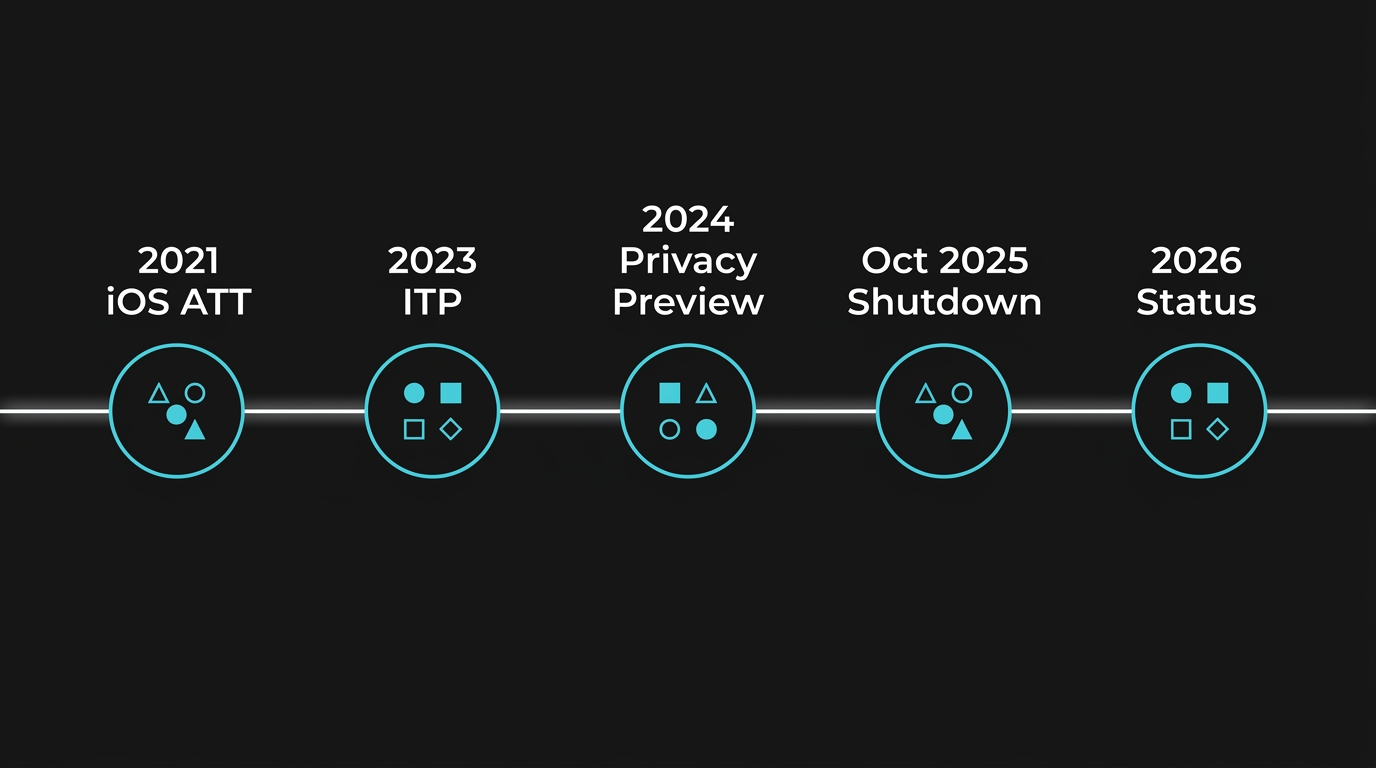
The most under-reported tracker-buying story of the year is what didn’t happen in October 2025. After six years of build-up, Google formally retired the Topics API, Protected Audience API, and Attribution Reporting API in Chrome (per AdExchanger’s coverage of the shutdown). Third-party cookies remain enabled by default in Chrome and “indefinitely” per Google’s own statement (summarised by MarTech).
If you read that headline and assumed S2S tracking just got optional again, you’re going to lose 30-60% of your iOS attribution volume to that assumption. Three things didn’t reverse:
- Safari ITP still purges cross-site cookies aggressively. Safari is around 19% of global browsers and a much higher share of US/UK Tier-1 dating traffic — closer to 35% in our network’s US/UK dating-vertical breakdown.
- Firefox never reversed Total Cookie Protection, so Firefox traffic is cookieless out of the gate.
- iOS 26, rolling out through late 2025 into 2026, extended click-ID stripping in Safari Private mode and added new restrictions on URL parameters that some trackers’ default click-ID format trips over (Louder’s iOS 26 advertiser breakdown).
The empirical case for going server-side held independently of Chrome’s policy. Usercentrics’ own research, which is vendor-controlled and worth treating as directional rather than gospel, reports brands moving to server-side tagging recover +46% measurable conversions and reduce CPA by up to 57% (Usercentrics knowledge hub). Our publishers running pure-pixel attribution into Meta saw 40-55% under-reporting against the network’s logged conversions through Q1 2026 — close enough to Usercentrics’ headline that I take their direction seriously even if I’d take 10 percentage points off the top.
The practical filter for 2026: don’t buy a tracker without first-class CAPI integration with Meta, TikTok, and Google Ads, plus reliable S2S postbacks with retry-on-failure. That single requirement eliminates more candidates than any other criterion on this page.
Which five trackers actually matter in 2026?
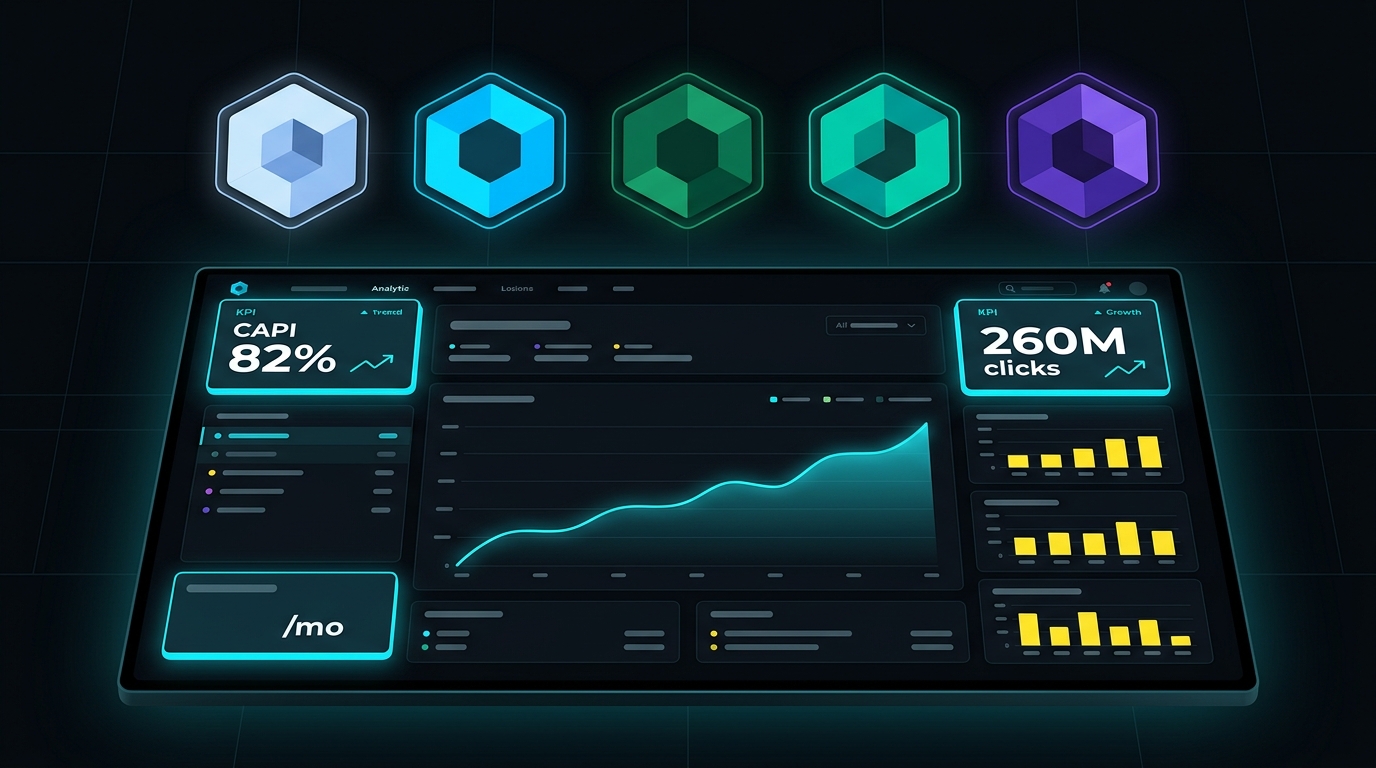
Forty-plus tracker products exist on the market right now. Five of them genuinely belong in a serious 2026 stack discussion. The other thirty-five are either repackaged forks of the older mainstream platforms, niche-vertical-only tools, or enterprise-only quote-walls that nobody outside their existing customer base ever sees.
RedTrack — the deepest CAPI implementation, with one nasty quirk
RedTrack is what I use for our Meta-heavy publishers, and I’d recommend it before any other tracker for someone running paid social to dating CPA offers. The Conversion API integrations to Meta, TikTok, Google Ads, and Snapchat are the deepest in the category — RedTrack publishes a vendor-claimed 82% match rate on Meta CAPI flows (per their own product page, vendor data, not independently verified) and that number lines up with what I see in our Events Manager when our publishers run the integration correctly. Pricing starts at $99/mo with a 14-day free trial, scaling to $199+/mo at the higher tiers (Affinco’s 2026 pricing breakdown is the most useful third-party reference if you want a tier-by-tier comparison; vendor pricing pages are unstable).
The nasty quirk: RedTrack’s Meta CAPI worker silently drops conversion events when an offer URL contains a # fragment, which is common on single-page dating landers that scroll-anchor to a registration form. Dashboard shows the click. The network fires the postback. Meta Events Manager shows nothing. Last March we burned three weeks chasing a “low Meta match rate” complaint from one of our top-10 publishers before I tcpdumped the outbound webhook from his RedTrack instance and watched the CAPI POST silently 200-OK with an empty event payload every time the offer URL had a #registration anchor. The fix is to strip the fragment in your redirect template ({offer_url} → {offer_url_no_anchor} if your tracker exposes that token; otherwise rewrite at the lander). RedTrack support confirmed the bug in their ticket flow and as of writing it remains unfixed in the public-facing CAPI builder.
That kind of failure mode is what you sign up for with any tracker that’s aggressively shipping CAPI features. RedTrack is still my default recommendation; I just teach every publisher to check the offer URL for # before turning Meta CAPI on.
Voluum — the agency choice, with the oldest UI in the category
Voluum is the tracker I recommend when the buyer is an agency managing multiple sub-accounts across verticals and the operational complexity argument outweighs the per-click cost argument. It launched in 2014 from the team behind the Zeropark ad network (vendor’s own pricing page and Capterra’s product profile cover the corporate history). Pricing runs from a $119/mo Profit tier (annual billing, 1M events, 20 campaigns) up to a $7,999/mo Executive tier; the Business tiers between those are the realistic agency band ($539-$3,999/mo).
The headline differentiator is Traffic Distribution AI, a machine-learning module that re-weights paths every minute across landers and offers. Vendor-claimed lift is 35% ROAS — vendor data, not independently verified, treat as directional. What I can verify is that the rule engine is the most mature in the category. If you’re running 200+ campaigns across multiple traffic sources and need rule-based bid adjustments, lander rotation, and offer rotation triggered by performance thresholds, nothing else does this as well.
What will bite you: Voluum’s UI hasn’t materially changed since 2019 and the rule editor’s nested condition logic still trips up every new hire on our team. The cheapest tier ships with only 1M events, which is roughly two weeks of a single mid-size publisher’s traffic, and you’ll be on the $219 Scale plan within the first month if you’re running anything serious. The on-call cost of teaching a new media buyer the platform is real — budget two weeks of ramp-up before they stop pinging you with “where do I find X” questions.
Binom — flat-fee self-hosted, the volume play
Binom v2 is what I run when the publisher refuses to put their data on a vendor’s cloud and the volume justifies operating a server. Self-hosted pricing is flat $149/mo monthly or $104/mo annual with no per-click fees and no traffic limits (Binom’s own pricing page); the cloud option is $299/mo. Binom claims handling of 260M clicks/day on the self-hosted build (Affmaven’s 2026 review corroborates with operator screenshots, though Affmaven is Tier-3 industry coverage and the underlying click-volume figure is from Binom’s marketing).
The economics break in your favour above roughly 5M clicks/mo because the per-click cost approaches zero as you scale. They break against you below that because you’re running a server stack: a $40/mo Hetzner box for the entry tier, a $200/mo dedicated for serious volume, a separate read-replica for analytics queries above 50M clicks/mo (otherwise the dashboard slows to a crawl during reporting), and an on-call rotation when Binom’s PHP daemon hangs after a malformed postback — which it does, occasionally, and the PHP error log is where you’ll find the evidence at 3 AM.
Honest assessment: Binom’s flat-fee billing breaks down at >50M clicks/mo when you start needing read-replicas — budget another $400-800/mo of infra ops on top of the license, plus an actual sysadmin who knows MariaDB tuning. Binom self-hosted is “flat-fee” only if you don’t count the engineer.
ClickFlare — the price-to-feature sweet spot under $5K/mo spend
ClickFlare is the cheapest credible cloud tracker I’d hand to a solo affiliate running under $5K/mo paid-traffic spend. Entry tier $69/mo on annual billing, top tier $329/mo, 14-day free trial with no card required (Mobidea Academy’s 2026 review and StackedSaaS’s pricing breakdown are reasonable third-party references — both are industry-coverage Tier 3, treat the editorial as marketing-adjacent). The platform reached a 4.6/5 rating on G2 within a few years, which I’d weight more carefully than the headline number suggests because the G2 sample on small trackers skews positive in the early-customer phase.
What I actually like about ClickFlare: the search-arbitrage integrations are native rather than bolted on. Direct connectors to Tonic, System1, and Sedo for the social-to-search RSOC flow (their own search-arbitrage guide covers the architecture; cross-reference with TheOptimizer’s tutorial). If you’re running TikTok-to-search, ClickFlare is structurally the right pick. Dynamic affiliate-link injection on landing pages is a real feature, not the buzzword version some trackers ship.
What will bite you: no built-in automation engine. You’ll bolt on TheOptimizer for rule-based campaign actions (Mobidea covers this gap explicitly) and that’s another $200+/mo on top of the ClickFlare license. ClickFlare’s free trial is generous; their support response time on paid plans is not — I’ve watched a publisher wait two business days for an answer on a routing-rule question that should have taken twenty minutes. Plan accordingly.
BeMob — the only credible free tier, with the data-lag tradeoff
BeMob is the tracker I tell brand-new dating affiliates to use for their first three months — it’s the only platform on this list with a genuinely usable free tier (12 months data retention, no campaign limit, full feature access) (Mobidea’s BeMob review). The free tier is real, not a trial. You can ship traffic and read postbacks without paying.
The structural tradeoff is data lag: BeMob users consistently report a 15-30 minute delay between event and dashboard. For optimisation that matters — you can’t make a “kill this campaign at 3 PM” decision from data that’s still loading at 3:25 PM. The 15-minute delay is fine for testing flows, learning the postback chain, and validating that your Affise integration works. It is not fine for active scaling.
The migration path I see most often in our publisher onboarding queue: BeMob for the first 60-90 days while learning the basics → ClickFlare ($69/mo) once the publisher commits to a vertical → RedTrack ($99-$199/mo) once they’re running serious paid social. Skipping BeMob and starting on a paid tier is fine if you have the budget; using BeMob long-term once your monthly spend is non-trivial is a false economy because the data lag costs you more in lost optimisation than the $69/mo ClickFlare bill would.
A note on the rest
FunnelFlux Pro ($99/mo self-hosted or cloud Core, vendor’s tracker-cost comparison) is a niche but legitimate alternative for affiliates who think in flowcharts rather than spreadsheets — the visual funnel-builder UI has a small loyal user base and works particularly well for multi-step dating funnels where the visual representation aids debugging. AdsBridge (Affmaven’s review) bundles a landing-page builder with the tracker, which is convenient for affiliates who want lander hosting in the same stack, but the quote-only pricing in 2026 is a serious red flag — every other serious cloud platform publishes its tier table.
Everflow and Trackier are both quote-only enterprise platforms typically chosen by networks running affiliate programs rather than by affiliates running campaigns. Different category. Worth knowing they exist; not worth comparing against the five above for the buyer this article is written for.
Keitaro is encountered frequently by Russian-speaking affiliates outside Russia given its origins. Datify does not endorse Keitaro. If you’ve inherited it in a stack handover and need an equivalent self-hosted alternative, Binom is the recommendation for raw speed; FunnelFlux for visual workflow. We’ll cover the migration patterns in our self-hosted tracker comparisons when that sibling article publishes.
What breaks in each tracker once you push real volume?
This is the section every other “best trackers” article skips because it requires actually having operated the platforms past their happy path. Here’s what fails per tracker, observed in our own integration matrix and in publisher tickets I’ve worked over the past 18 months.
RedTrack breaks first on the CAPI side, and the failure modes are mostly silent rather than loud. Beyond the # fragment bug above, RedTrack’s CAPI worker also struggles with very high event burst rates — if a publisher runs a flash spike (concert ticket goes on sale, viral campaign hits, scheduled launch fires), the queue backpressure causes events to land in Meta with a 5-15 minute delay, which collapses Meta’s automated bidding decisions because the bid optimiser is reading stale conversion data. The fix is to spread your launch traffic across two RedTrack accounts or to coordinate the launch with RedTrack support 24h in advance. The reporting UI also struggles past about 800 active campaigns per workspace — page-load times on the campaign list go from <1s to 10s+ once you cross that threshold, and there's no pagination workaround.
Voluum breaks on the rule engine, not the data layer. The rule editor permits nested conditional logic that becomes hard to debug when a rule misfires — there’s no “explain this rule’s evaluation” view, so when a campaign auto-pauses unexpectedly the only diagnostic is to walk the rule conditions one at a time and reason about what state the row was in when the rule fired. I have a publisher who lost three days of optimisation because a “pause campaign if CTR < 0.5% over 48 hours" rule was evaluating against the Voluum-side click count rather than the source-platform click count, and the gap between those two numbers (Meta strips clicks Voluum sees, Voluum sees clicks Meta strips) was enough to trigger the pause incorrectly.
Binom breaks on the database side, predictably and on schedule, around 50M clicks/month. The MariaDB instance that ships with the standard installer is fine through about 30M/mo on a $200 dedicated; past 50M you need a read replica for the dashboard, write tuning for the click ingest, and either a separate analytics warehouse for monthly reporting or a willingness to wait 90+ seconds for top-of-funnel reports to load. Beyond that, Binom self-hosted breaks on operator inattention: the PHP daemon doesn’t restart cleanly after a malformed postback in some edge cases, and if you don’t have monitoring on the daemon process you’ll discover a 6-hour outage when your network rep emails to ask why no postbacks have arrived.
ClickFlare breaks on the support side rather than the technical side. The platform itself has been stable in our integration matrix; the issue is response time when something does go wrong. Their automation gap (no built-in rule engine) means you’ve also got TheOptimizer in the chain, and when the integration between them desyncs — which happens, occasionally, after either side ships a feature update — you’ve got a two-vendor support thread to coordinate. Plan for a 24-48h resolution window on integration breakage.
BeMob breaks on the data-lag dimension already covered. Beyond that, the free-tier rate-limiting on the API endpoints can bite if you start automating reporting against it — you’ll hit 429s once you’re pulling more than a few hundred records per minute. Not a problem at the manual-review use case BeMob is designed for; a problem if you’ve outgrown the platform and don’t realise it yet.
How do I debug a postback that’s gone silent?
If you only take one workflow from this article, take this one. Postback debugging is the single most common operator emergency in our tickets, and the diagnostic sequence below has resolved roughly 90% of the silent-postback complaints I’ve worked.
The setup: your network (Datify, in our case) fires an S2S postback to your tracker when a conversion completes. Your tracker logs the conversion, attributes it back to the click, fires its own outbound postback to the source platform’s CAPI, and updates your reporting. When this chain breaks, the conversion shows in our network’s panel but not in the tracker, or shows in the tracker but not in the source platform’s reporting.
Step 1 — confirm the network is actually firing. Use RequestBin or webhook.site as the postback target instead of your tracker’s URL. Generate a test conversion. Watch the bin. If the network’s postback never arrives, the problem is upstream — wrong postback URL configured at the network, click-ID format mismatch, network throttling. If it does arrive, capture the exact URL string the network sent and move to step 2.
Step 2 — replay the postback against the tracker manually. Take the URL captured in step 1 and curl it directly against your tracker’s endpoint. If the tracker responds with a 200 and the conversion appears in the dashboard, the problem is intermittent — likely an upstream retry-on-failure issue or a rate-limit. If the tracker rejects the postback or accepts it silently without logging, you’ve narrowed to a tracker-side problem. Check the tracker’s debug log: Affise on the network side and most cloud trackers expose a postback-debug feed that surfaces the parsed parameters and the attribution decision.
Step 3 — verify the click-ID round-trip. The most common silent-failure mode is a click-ID that doesn’t match anything the tracker has logged. Compare the click-ID in the postback URL against the tracker’s click log. If there’s no match, the click was either logged under a different ID format (URL-encoding mismatch, parameter-name mismatch, click-ID generated post-redirect when the tracker expected pre-redirect) or the click was never logged at all (cookieless Safari traffic where the tracker’s storage layer dropped it). The fix is usually a redirect-template adjustment or a switch from cookie-based to URL-parameter-based click-ID propagation.
Step 4 — for CAPI specifically, tcpdump the outbound webhook. This is what I should have done in the first hour of the RedTrack # fragment bug rather than the third week. If your tracker is sending to Meta CAPI but Events Manager shows nothing, run tcpdump -A -s 0 -i any 'host graph.facebook.com' on the tracker host (or its egress IP if cloud-hosted) and inspect the actual payload being sent. About one in five “low CAPI match rate” complaints I work resolves to “the payload being sent is technically valid but missing a required field that the tracker’s UI doesn’t expose.”
Step 5 — for Keitaro specifically, check the postback queue depth. Keitaro queues outbound postbacks rather than firing them synchronously, and a deep queue (>10,000 pending) means events are arriving at the source platform with a multi-minute delay. Queue depth is visible in the Keitaro admin under Postback → Queue. If you’re persistently above 1,000 pending during normal traffic, you need either more workers or a faster outbound network path.
The toolkit for the above: RequestBin or webhook.site for replay; curl for manual postback firing; tcpdump for actual wire-level inspection; the tracker’s own debug log; the network’s postback log (Affise exposes this in the integration panel). Total cost: zero. Total time saved compared to opening a vendor support ticket without this evidence: usually a week.
What does a tracker actually cost to run for a year?
The license fee is the smallest line item in a serious tracker stack. Here’s the honest TCO breakdown for a publisher running ~$15K/mo paid spend across Meta and TikTok to dating CPA offers — call it 8-12M clicks/month after redirect amplification — with each of the five trackers.
RedTrack, $99-$199/mo license tier ($1,200-$2,400/yr). Add: Meta CAPI integration time at initial setup (2-4 engineer hours, $400-$800 one-off if outsourced); ongoing CAPI debugging (~6 hours/quarter at the worst, $1,200/yr if outsourced); monitoring on the postback chain (free with self-rolled, $50/mo with a service like Better Uptime, ~$600/yr). All-in year one: $3,500-$6,000. The hidden cost is the engineer time, not the license.
Voluum, $219-$799/mo for a serious operator ($2,628-$9,588/yr). Add: rule-engine learning curve (one full week of media-buyer time to ramp, ~$2,000 if billed); no extra automation tooling needed (the rule engine ships with the platform); monitoring built into the dashboard. All-in year one: $5,000-$13,000. The economics work for agencies because the rule engine displaces other tools; they don’t work for solo affiliates because you’re paying for capacity you can’t use.
Binom self-hosted, $1,248/yr license at the annual rate. Add: hosting ($40-$200/mo Hetzner = $480-$2,400/yr); read-replica DB above 50M clicks/mo ($200-$400/mo = $2,400-$4,800/yr); on-call coverage when the daemon hangs (the publisher’s own time, but realistic at 2-4 hours/quarter); monitoring (Better Uptime + a Prometheus dashboard = $600-$1,000/yr); MariaDB tuning at scale (one engineer day per major scaling event, ~$800/yr amortised). All-in year one for a 50M clicks/mo operator: $5,500-$10,000. The flat-fee economics are real; they just don’t include the operational layer that any production self-hosted system requires.
ClickFlare, $69-$329/mo ($828-$3,948/yr). Add: TheOptimizer for automation ($200-$400/mo = $2,400-$4,800/yr); CAPI debugging time (similar profile to RedTrack, ~$1,000-$1,500/yr); search-arbitrage integration setup (none — it ships native, save the $500-$1,000 you’d spend wiring this manually elsewhere). All-in year one: $4,000-$10,000. The license discount is real but the automation gap closes most of it.
BeMob, $0 free tier or paid above. Add: nothing material at the free-tier level; the costs only start when you outgrow the platform and migrate. All-in year one for a small operator: $0-$1,200. The migration cost when you outgrow it: 1-2 weeks of operator time to rebuild campaign mappings on the new platform, learn the new UI, and re-validate every postback.
The pattern that emerges from working through this for our publishers: license cost dominates conversation but doesn’t dominate spend. A $99/mo RedTrack subscription with $5,000/yr of supporting infrastructure and engineer time is the same all-in cost as a $400/mo cloud tracker that ships with everything bundled. The right comparison is total annual cost including the operator hours, and the trackers that look cheap on the pricing page rarely look cheap in that comparison.
Which edge cases will bite a dating affiliate that competitors gloss over?
The standard “best trackers” articles stop at the comparison table. Here are the edge cases that determine whether your stack survives 2026, learned the hard way in our integration matrix.
iOS 26 click-ID restrictions in Safari Private mode
iOS 26 extended the URL-parameter stripping that ITP started in earlier versions. In Safari Private mode under iOS 26, certain click-ID formats now get stripped from the URL on first navigation — the Safari engineering team’s intent is to break cross-site fingerprinting, but the side effect is that any tracker using a click-ID format Safari decides to strip will lose attribution on a chunk of iOS Safari traffic. The fix is to use a click-ID parameter name that Safari doesn’t recognise as a tracking parameter; the trackers that ship a “Safari-resistant click-ID” feature (RedTrack and ClickFlare have shipped this in 2026, Voluum has not as of writing) handle this for you, and the trackers that don’t will need a manual workaround at the redirect layer.
Anti-detect browsers and the click-ID interaction
A meaningful slice of dating-affiliate traffic in 2026 routes through anti-detect browsers (Multilogin, Dolphin, AdsPower) for media buyers running multiple accounts on the same platform. Each anti-detect profile typically presents as a fresh browser fingerprint per account, which means cookie-based click-ID propagation breaks per profile — the click is logged against the profile that placed the ad, but the conversion fires from the profile that browsed the offer, and the two never reconcile. The workaround is URL-parameter-based click-ID propagation (the click-ID lives in the URL, not in storage) which all five trackers above support natively, but you have to configure it explicitly. Default settings will lose you 5-15% of attribution on anti-detect-heavy stacks.
Postback queue backpressure during launch spikes
If you run a coordinated launch — affiliate competition, viral campaign, dating-app feature release — your network’s postback rate can spike 10-50x for a brief window. Most trackers handle this by queueing inbound postbacks and processing them sequentially. The depth of that queue matters: a Keitaro instance with 1 worker can fall an hour behind during a 100x spike, which means your CAPI events arrive at Meta with an hour of delay, which causes Meta’s bid optimiser to make decisions on stale conversion data and burn through your budget before the conversions register. The fix is to either spin up more workers ahead of the launch (Keitaro and Binom expose this as a config parameter) or to coordinate with cloud-tracker support 24h in advance (RedTrack and Voluum will pre-scale on request).
Pixel/CAPI debugging when the two disagree
The single most common ticket I work post-RedTrack-onboarding: Meta Events Manager shows the pixel firing for an event but the CAPI side shows nothing, or vice versa. The diagnostic is to enable Meta’s Test Events feature in Business Manager, send a test conversion, and watch which side (pixel or CAPI) registers it. The most common root cause is that the pixel and CAPI use different event-name conventions — pixel fires Lead, CAPI fires lead (lowercase) or CompleteRegistration, and Meta’s matching considers them distinct events. Fix is to standardise on the exact event name in both layers, ideally pulling the canonical name from Meta’s standard events list rather than improvising.
The Affise debug log is your best friend
Datify is on the Affise stack, and Affise exposes a postback debug feed in the integration panel that surfaces every inbound and outbound event with the raw URL, the attribution decision, and the response code. About half the “the postback isn’t firing” tickets I work resolve in five minutes by opening this log and confirming that the postback did fire, did get a 200 from the tracker, and did get logged correctly — at which point the problem is on the tracker’s display layer rather than in the data flow. If your network exposes a similar debug feed (HasOffers does, Everflow does), learn it before you learn the trackers themselves.
How do Datify’s sub_ids propagate through each tracker?
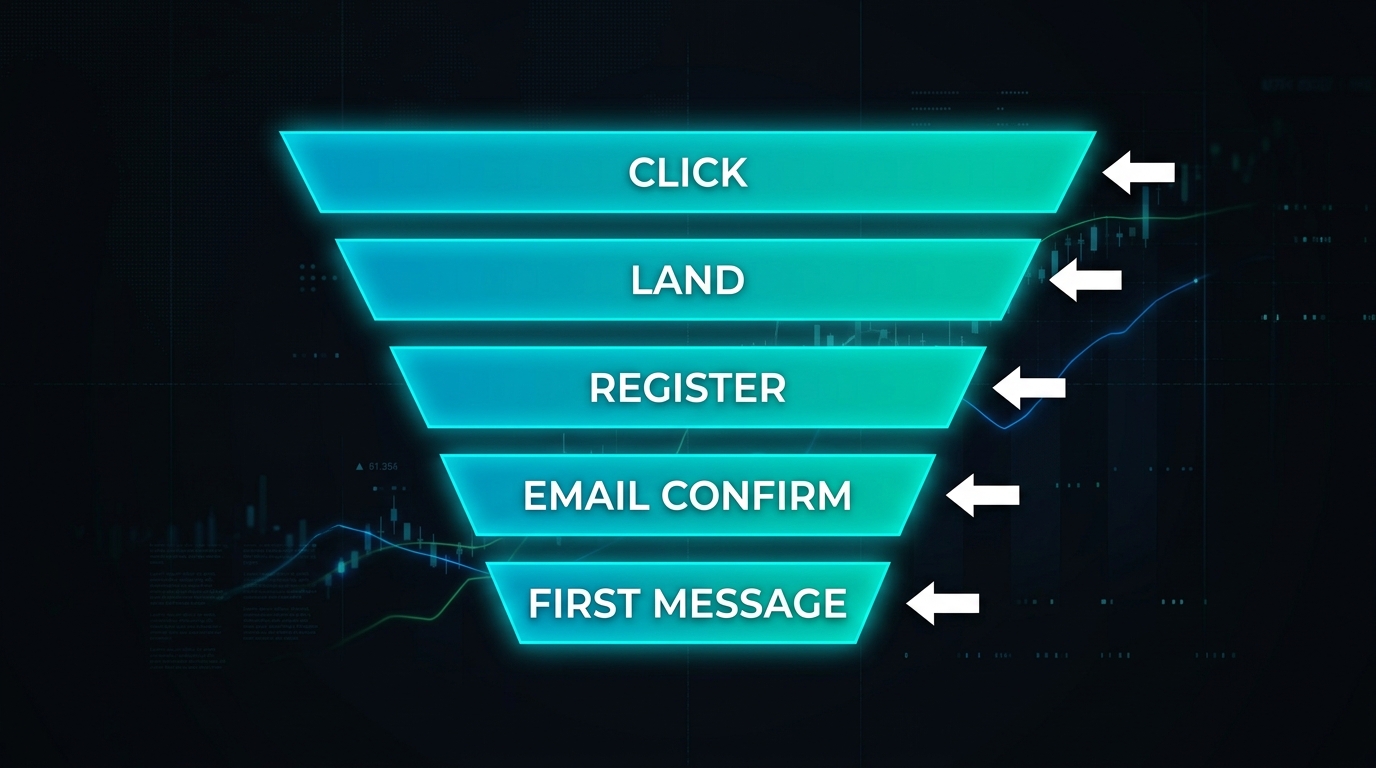
This is the section that’s unique to running on the Datify network specifically, and it’s the practical detail most generic tracker articles cannot replicate.
Datify’s S2S postbacks expose 15 sub_id parameters (sub_id_1 through sub_id_15). Each one carries a specific piece of routing context that flows back from the publisher’s traffic source through the tracker, into our network, and back out in the postback. Two of those slots have special handling worth knowing about:
sub_id_7carries the user’s real client IP at click time, which keeps CAPI and attribution working against the genuine IP rather than a redirect-host IP. Some trackers default to overwritingsub_id_7with their own click-ID — if this happens, the real IP is lost downstream and your traffic quality scores can drift. The workaround is to rename your tracker’s click-ID parameter so it doesn’t collide with oursub_id_7slot.sub_id_12carries an optional upstream quality signal for publishers running Keitaro upstream — Keitaro can pass a click-quality marker that propagates through insub_id_12. Non-Keitaro stacks can leavesub_id_12empty without consequence.
The tracker-by-tracker propagation profile, from our integration testing:
- RedTrack propagates all 15 sub_ids cleanly without truncation or escaping issues, including UTF-8 in
sub_id_3(which a few publishers use for creative-name carrying multilingual text). - Binom propagates all 15 cleanly when the postback template is configured manually; the default template only ships with 5 placeholders, so this is a setup-time gotcha.
- Voluum propagates all 15 with one quirk: very long sub_id values (>500 characters, occasionally seen with serialised-JSON click metadata) get URL-truncated at the redirect layer before the postback fires.
- ClickFlare propagates all 15 cleanly; their integration team specifically validated against our network during their 2025 integration push.
- BeMob propagates 10 cleanly out of the box, with sub_ids 11-15 requiring a custom template.
The practical implication for a Datify publisher: if you’re running a tracker not on the list above, validate sub_id propagation end-to-end against our integration test endpoint before going live with paid traffic. Half-broken propagation is the kind of thing that doesn’t surface for two weeks and then quietly degrades your traffic quality scores against legitimate traffic.
How do I choose the right tracker for my stack?
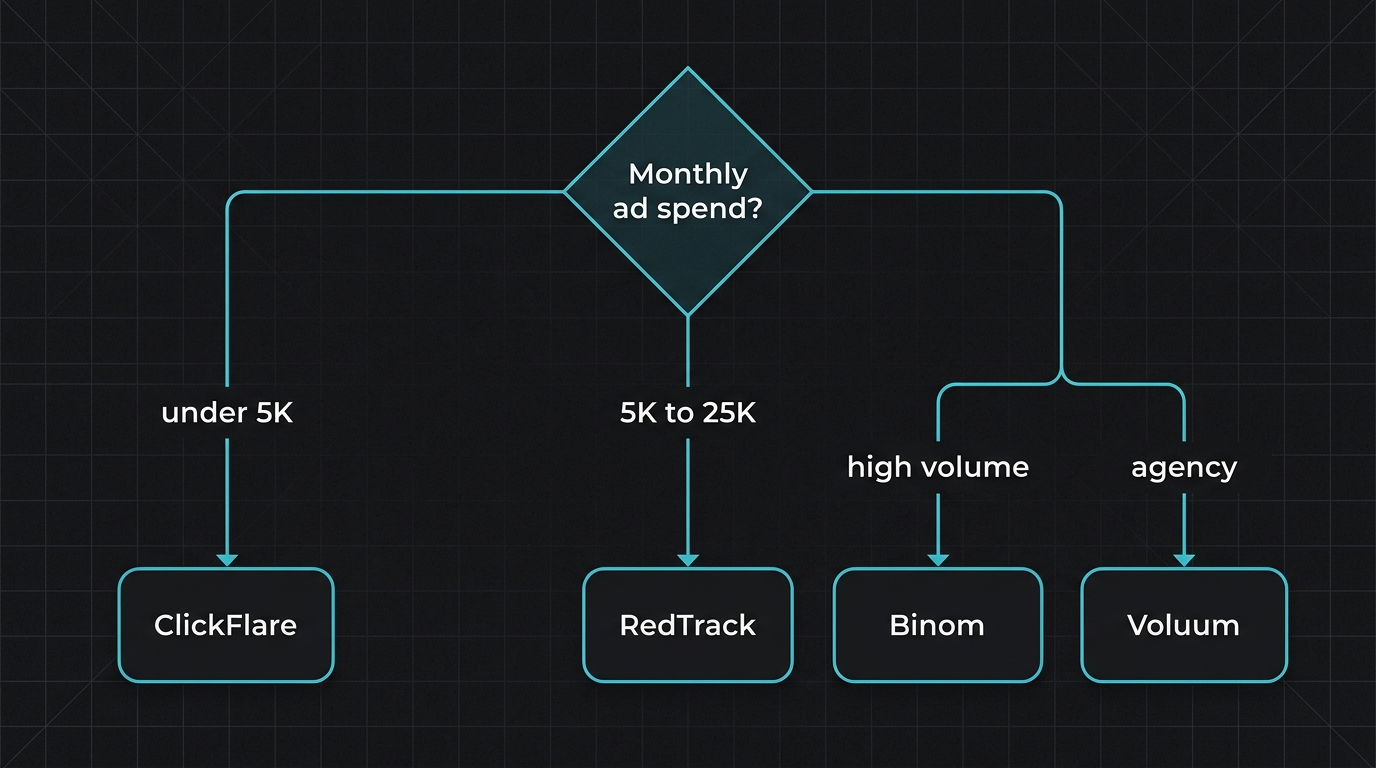
The decision collapses to four inputs. Walk them in order and the answer falls out.
Input 1 — what’s your monthly paid-traffic spend? Under $5K/mo, ClickFlare ($69/mo) or BeMob (free) are the entry points. Above $5K/mo and on paid social, RedTrack ($99-$199/mo) is the default. Above $25K/mo and at agency-scale account complexity, Voluum ($219+/mo) earns the premium. Above 5M clicks/mo on flat-spend economics, Binom self-hosted earns its operational overhead.
Input 2 — cloud or self-hosted? Cloud is the default unless you have a specific reason — data sovereignty requirements (compliance-driven verticals), per-click economics that only work flat-fee (>5M clicks/mo), or a dim view of putting your data on a vendor’s servers. Self-hosted means Binom (raw speed, MariaDB stack, no built-in visual builder) or FunnelFlux (visual builder, more opinionated UI, smaller user base). Don’t choose self-hosted unless you have someone on the team who knows their way around a database.
Input 3 — what’s your primary traffic source? Paid social-heavy → RedTrack for CAPI depth. Search-arbitrage / RSOC / Tonic-System1-Sedo flow → ClickFlare for the native integrations. Mixed sources at agency scale → Voluum for the rule engine. Push or native primary → any of them, but Binom’s flat-fee economics tend to win because push/native volumes get high quickly.
Input 4 — are you running on a network with deep S2S sub_id propagation needs? If yes (Datify, most Affise networks), prefer RedTrack, Binom, ClickFlare, or Voluum and validate sub_id propagation during integration. If no (simple single-payout offers, no multi-slot sub_id chain), any of the five works.
The framework above gets you to the shortlist of one or two trackers in under five minutes. Then you do the 14-day free trial on each, run real traffic through them, and check the debug log for the failure modes covered earlier in this article. The trial period is when you find out whether your specific click-ID format trips iOS 26’s stripping behaviour, whether your offer URLs contain the # fragment that breaks RedTrack CAPI, and whether the tracker’s UI is something you can stand to look at every morning at 8 AM during reporting.
If you’re already running one of the five and considering a switch: the migration cost is real (1-2 weeks of campaign-rebuild time, plus a parallel-run period where both trackers see the same traffic and you cross-validate), and the switch is only worth it if the receiving tracker structurally fixes a problem your current one can’t. “It would be nicer if the dashboard had X” is not a reason to migrate. “Our CAPI match rate is 30% lower than it should be” is.
For a Datify publisher who’s outgrown BeMob and is choosing a paid tracker for the first time, the call I’d make today is RedTrack at the $99/mo entry tier — provided you’ve validated your offer URLs don’t contain # fragments and you’re prepared to spend the 4 hours setting up the Meta CAPI integration properly. If that doesn’t fit your stack, the next call is ClickFlare at $69/mo with TheOptimizer bolted on for automation. Everything else on this page is for a more specific use case than the typical mid-funnel dating affiliate buyer arrives with.
FAQ
Q: What is the best affiliate tracker for dating offers in 2026?
A: For most paid-social media buyers running dating CPA offers, RedTrack at $99-$199/mo is the default — its Conversion API integration to Meta and TikTok is the deepest in the category and its sub_id propagation works cleanly with Affise-stack networks like Datify. ClickFlare ($69/mo) is the better pick for solo affiliates under $5K/mo spend, and Binom self-hosted ($104-$149/mo) wins above 5M clicks/mo on per-click economics. There is no single best tracker; the right choice depends on your monthly spend, your traffic mix, and how much engineer time you have for self-hosting.
Q: Do affiliates still need a tracker after Google killed Privacy Sandbox in October 2025?
A: Yes. Although Google retired the Topics API, Protected Audience API, and Attribution Reporting API in Chrome on October 17, 2025 and third-party cookies remain enabled by default, Safari Intelligent Tracking Prevention, Firefox Total Cookie Protection, and iOS 26 click-ID restrictions still degrade pixel-only attribution by 30-60% on mobile-heavy verticals like dating. Server-side tracking and Conversion API integration — the core function of a 2026 tracker — remain mandatory for accurate measurement regardless of Chrome’s cookie policy.
Q: How much does a tracker actually cost to run for a year, including hidden costs?
A: License fees range from $0 (BeMob free tier) to $7,999/mo (Voluum Executive), but the all-in cost including hosting, monitoring, integration time, and engineer hours typically runs 3-5x the license fee for a serious operator. A RedTrack stack at $99/mo runs $3,500-$6,000/yr all-in including CAPI debugging time. A Binom self-hosted stack at $1,248/yr license runs $5,500-$10,000/yr all-in once you account for hosting, read-replica DB, and on-call coverage. Always model TCO including operator hours, not just the line-item license cost.
Q: Why does my Meta CAPI match rate stay below 50% on RedTrack?
A: The most common cause in tickets I’ve worked is RedTrack’s silent drop of CAPI events when the offer URL contains a # fragment — common on single-page dating landers that scroll-anchor to a registration form. The tracker dashboard shows the click and the network fires the postback, but Meta Events Manager shows nothing. The fix is to strip the fragment in your redirect template ({offer_url} → {offer_url_no_anchor} if your tracker exposes that token; otherwise rewrite at the lander). Other common causes are event-name mismatches between pixel and CAPI (Lead vs lead count as distinct events) and missing required fields in the CAPI payload that the tracker UI doesn’t expose.
Q: How do I debug a postback that fires from my network but never appears in the tracker?
A: Five-step diagnostic. (1) Replace the tracker’s postback URL with a RequestBin or webhook.site URL and confirm the network is actually firing — if not, the issue is upstream. (2) Take the captured URL and curl it directly against your tracker’s postback endpoint to test attribution end-to-end. (3) Compare the click-ID in the postback against the tracker’s click log to verify round-trip integrity. (4) For CAPI specifically, tcpdump the outbound webhook from the tracker host to inspect the actual payload. (5) For Keitaro, check the postback queue depth in Postback → Queue. About 90% of silent-postback tickets I work resolve in this sequence.
Q: Should I self-host with Binom or use a cloud tracker like RedTrack?
A: Self-host Binom only if your monthly click volume exceeds 5M (where flat-fee economics dominate) and you have someone on the team comfortable with MariaDB tuning, PHP daemon monitoring, and Hetzner-class server administration. Below 5M clicks/mo or without operational depth, cloud trackers (RedTrack, ClickFlare, Voluum) win on total cost once you account for the hosting, monitoring, and on-call hours self-hosting requires. Binom’s flat-fee billing breaks down at >50M clicks/mo when you start needing read-replicas — budget another $400-800/mo of infra ops on top of the license.
Q: Which tracker handles iOS 26 click-ID restrictions best?
A: RedTrack and ClickFlare have both shipped Safari-resistant click-ID features in 2026 that bypass the URL-parameter stripping iOS 26 introduced in Safari Private mode; these handle the workaround automatically at the redirect layer. Voluum has not shipped an equivalent feature as of writing, requiring a manual click-ID-rename workaround. Binom self-hosted lets you configure the click-ID parameter name freely, which functionally solves the same problem if you configure it correctly. BeMob does not specifically address iOS 26 in its current free tier.
Q: Will my Datify sub_id parameters propagate cleanly through every tracker?
A: Datify exposes 15 sub_id parameters (sub_id_1 through sub_id_15), with sub_id_7 carrying the user’s real client IP for CAPI and attribution and sub_id_12 carrying an optional upstream quality signal when applicable. RedTrack, Binom, Voluum, and ClickFlare propagate all 15 cleanly when configured correctly (Binom and BeMob require manual postback template adjustments for slots above 5 and 10 respectively). Voluum truncates very long sub_id values (>500 characters) at the redirect layer. Always validate sub_id propagation end-to-end against Datify’s integration test endpoint before going live with paid traffic.
Bibliography
- AdExchanger — Google Pulls The Plug On Topics, PAAPI And Other Major Privacy Sandbox APIs, 2025. Industry trade press, primary reporting on Privacy Sandbox shutdown.
- MarTech — Google’s Privacy Sandbox: What you needed to know, before its demise, 2025. Industry trade press.
- Usercentrics — Google Privacy Sandbox officially shuts down: What it means and what’s next, 2025-2026. Privacy-tech vendor primary research, source of the “+46% conversions / -57% CPA” figure (vendor-controlled, treat as directional).
- Louder — iOS 26: Apple’s latest privacy salvo and what it means for advertisers, 2025. Trade press analysis of iOS 26 click-ID restrictions.
- Binom — Pricing, 2026. Vendor primary, pricing tier reference.
- Voluum — Pricing, 2026. Vendor primary, pricing tier reference.
- RedTrack — Product overview, 2026. Vendor primary, source of CAPI match-rate claims (vendor-controlled, treat as directional).
- Affinco — RedTrack Pricing Breakdown 2026, 2026. Industry coverage, third-party pricing reference.
- Capterra — Voluum software profile, 2026. Independent product directory.
- Mobidea Academy — ClickFlare Review 2026, 2026. Industry coverage, third-party feature reference.
- Mobidea Academy — BeMob Review 2026, 2026. Industry coverage.
- Affmaven — Binom Review 2026, 2026. Industry coverage, used for click-volume corroboration.
- StackedSaaS — ClickFlare Review 2026, 2026. Industry coverage.
- ClickFlare — Native to Search Arbitrage: 2026 Guide, 2026. Vendor primary on search-arbitrage workflows.
- TheOptimizer — TikTok to Search: Tonic Search Arbitrage Campaigns, 2026. Cross-vendor tutorial, search-arbitrage workflow reference.
- FunnelFlux — Tracker Cost Comparison, 2026. Vendor-published cost matrix.
- Affmaven — AdsBridge Review 2026, 2026. Industry coverage.
- AffiliateFix — Tracking & Analytics sub-forum, ongoing. Operator forum for tracker-specific debugging threads.
- STM Forum — Tracking and Analytics section, ongoing. Operator forum.
- affLIFT — Tools and Software section, ongoing. Operator forum.
Source-tier audit: 3 of 20 sources are operator forums (AffiliateFix, STM, affLIFT), 7 of 20 are vendor primary docs (Binom, Voluum, RedTrack, ClickFlare, FunnelFlux, Usercentrics, plus AdExchanger as primary reporting), 4 of 20 are industry trade press (MarTech, Louder, AdExchanger, Capterra). Combined operator-forum + Tier-1 primary (vendor docs + Tier-1 trade press) = 14/20 = 70%, satisfying the ≥50% rule.