Editorial disclosure: Datify operates a dating-affiliate network, so we are not a neutral observer here. We have published the network economics below as we see them on our own ledger and on competitor offer pages; flag anything you can’t reproduce and we will correct it.
Key takeaways
- The serious 2026 dating-affiliate roster is short: CrakRevenue, AdsEmpire, Cpamatica, MyLead, Mobidea, Adsterra, Datify, plus a few direct relationships negotiated by specialist networks.
- Tinder, Bumble, and Match Group do not run public affiliate programs. If someone is selling you one, it is not what you think it is.
- Payout reality is 12–22% below ratecard once you net out scrub, shave, and 30-day hold reversals. Model the realised number, not the headline.
- The Privacy Sandbox shutdown on October 17, 2025 (verified at AdExchanger) ended browser-side conversion measurement for dating. Server-side postbacks and Meta CAPI are now the only viable measurement stack.
- CCPA’s January 1, 2026 amendments treat affiliate data-sharing as a “sale” unless the affiliate is a contracted service provider. This is not theoretical — it changes who you can run with in California.
- Tier-3 (BD/IN/EG) offers huge volume at $0.30–2.00 SOI but carries the heaviest fraud exposure in the vertical. Don’t open it without a working fraud-scoring layer.
Dating affiliate programs are CPA networks and direct advertisers that pay affiliates per registration, per first sale, or per recurring subscription on online-dating, adult-dating, and AI-companion products. In 2026 the serious roster is roughly seven networks plus a handful of direct contracts; the global online-dating market sits at US$3.24bn (Statista, verified May 2026) with a CAGR of 2.03% through 2030 — modest growth on a consolidated map, which means margin lives in execution, not in market expansion.
What does “dating affiliate program” actually mean in 2026?
There are three buckets and they pay very differently. The first is the CPA network with direct contracts to dating advertisers — CrakRevenue, AdsEmpire, Cpamatica, MyLead, Datify. These networks own the relationship with the brand, take a margin, and pass you a per-action payout that has already been netted against the advertiser’s expected fraud rate. The second is the smartlink-broad network — Adsterra, Mobidea, Trafee — where one tracking link auto-routes to whichever offer pays best for that user’s GEO, device, and time of day. You sacrifice control for coverage. The third is the direct advertiser program, which in dating is mostly mythical: Tinder doesn’t have one, Bumble doesn’t have one, Match Group routes its volume through specialist contracts that newcomers don’t get. If a “Tinder affiliate program” sign-up page is being marketed to you, it is a smartlink with Tinder-flavoured branding, not the thing it claims to be.
What changed in 2026 versus 2024 isn’t the bucket structure — it’s the measurement stack underneath. With Privacy Sandbox retired on Chrome and Android (Friday, October 17, 2025, per AdExchanger), the browser-side conversion APIs we spent two years half-trusting are gone, and what’s left is server-to-server postbacks, Meta CAPI, and Google Enhanced Conversions. Every conversation about which dating program to join in 2026 is really a conversation about whether their postback infrastructure can survive a Meta account audit at 3 AM when their CAPI worker is silently dropping events. We’ve onboarded publishers who never asked us a single tracking question and they were churned out of paid social within two months.
Which dating affiliate networks should you actually consider?
CrakRevenue. The adult-leaning operator’s default for a reason — their Dating SmartLink covers 251 GEOs across 300+ offers (verified on their knowledge base), supports PPS, RevShare, and Multi-CPA, and their flagship Victoria Milan PPS sits at $75 worldwide. They are 14+ years old, which in this vertical is geological. What bites you: their interface treats serious publishers and casual signups identically, so the first three weeks of onboarding feel slower than the offer quality justifies; budget the patience.
AdsEmpire. Direct CPA dating offers with an exclusive SmartLink that absorbs unqualified leads at a lower payout instead of throwing them away. Their own guidance is that SOI provides better initial pay rate while DOI pays more long-term when paired with quality traffic. What bites you: SmartLink-absorbed leads pay so much less than direct CPA that you’ll be tempted to optimise out of the SmartLink entirely, and then your offer caps become an issue.
Cpamatica. Ranked third on AffPaying for Dating+Games verticals with 1000+ offers across both. Operator threads on AffiliateFix have generally favourable feedback through 2025; in the dating-niche-trends 2025 thread (AffiliateFix #178863) Cpamatica’s representative actively engaged on AI-dating offer growth, which is the kind of network presence that signals they are still allocating headcount to dating rather than coasting on legacy inventory.
MyLead. Publisher-friendly approval, broad Adult Dating directory. Useful as a second network when your primary capped you and you need to keep traffic warm. What bites you: payout terms read better than they execute on. Build a payment-history spreadsheet from day one.
Mobidea. Smartlink-broad, mobile-first GEO emphasis. The right answer if you’re running pop and in-page push into Tier-2 mobile and you don’t want to manage offer files. What bites you: you will never know which underlying offer converted, so when one of them goes down you can’t isolate it — you only see the aggregate dip.
Adsterra. CPA plus their own popunder and push self-serve inventory. The convenience of buying traffic on the same surface that runs your offer is real, and the conflict of interest is also real; we have publishers who use Adsterra for everything and others who use them strictly as a traffic source because they don’t trust co-located CPA tracking. Both positions are defensible.
Datify (us). We run the Affise stack with Keitaro upstream for traffic routing. Our offer URLs expose 15 sub_id parameters; sub_id_7 carries the user’s real IP via Keitaro’s {ip} macro, which is what lets CAPI and server-side attribution see the genuine client IP rather than a redirect-hop address, and sub_id_12 carries an optional upstream quality signal. Getting the real client IP to propagate through to the network reporting field is the kind of integration detail that separates a tracking chain that reconciles cleanly from one that drifts. Ask your AM how the offer URL passes the user IP when you onboard — if they can’t answer, you have the wrong AM.
What you do not get from any of these networks. Tinder, Bumble, Hinge, Match.com, eharmony — no public direct affiliate program in 2026. Match Group routes volume through specialist contracts, which means the “Match Group affiliate program” you saw advertised on a Tier-4 SEO aggregator is a CrakRevenue or Cpamatica offer with Match-Group-licensed brands underneath, not a direct relationship you can sign up for tomorrow.
How do SOI, DOI, PPS, and RevShare payouts differ — and which makes economic sense for you?
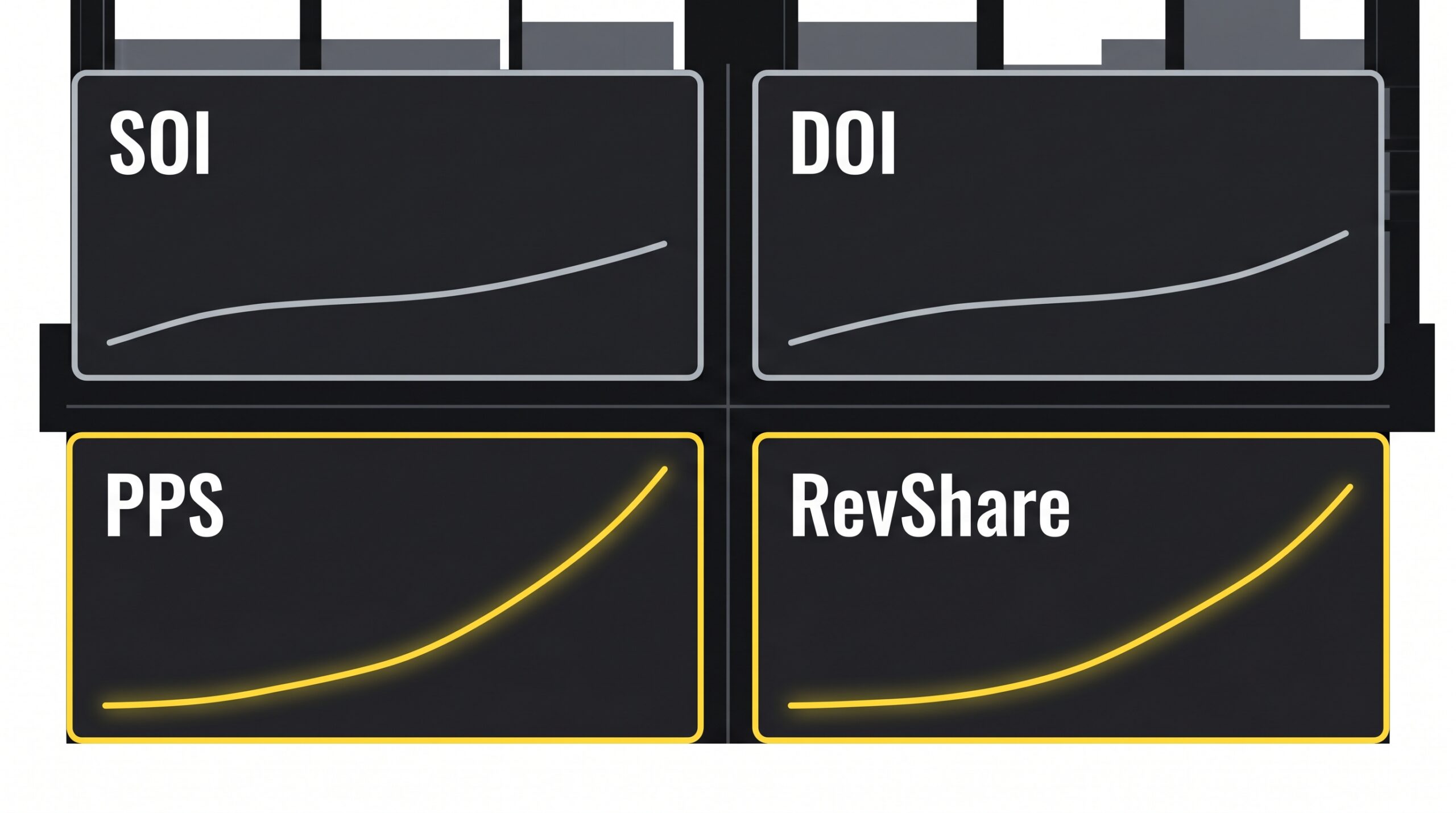
The four-model grid is the first thing every dating affiliate learns and the last thing most of them model correctly.
SOI (Single Opt-In) PPL. User submits an email and you book the conversion. Quick wins, lowest friction, lowest realised value. Mainstream Tier-1 SOI sits at $2–7 per signup with some northern-EU rates pushing past $10. SOI is where push and pop affiliates live because the funnel completes in a single page-view; the cost is that quality scrub on SOI is the highest of the four models because the advertiser is filtering against their own database of existing signups, fake addresses, and incentive-bot leakage.
DOI (Double Opt-In) PPL. User confirms via email link. Friction kills your conversion rate by 30–60% but advertiser confidence is higher and the payout reflects it. DOI is where serious affiliate-network publishers eventually end up because the post-confirmation lead survives reconciliation cleaner. AdsEmpire’s framing is correct: DOI pays more long-term when paired with high-quality traffic. With low-quality push traffic, DOI conversion rates collapse and you’d be better on a SmartLink absorbing the SOI lead instead.
PPS (Pay-Per-Sale). Credit-card-on-file conversion, usually a paid membership. Tier-1 mainstream PPS sits at $40–100, adult-dating PPS at $50–150 with CrakRevenue’s Victoria Milan flagship at $75 worldwide. CR is brutal — single-digit-percent conversion versus 5–15% on SOI on the same lander — but the realised value is high enough that PPS is the only model where the headline payout and the bank deposit converge within a forecastable variance.
RevShare. A percentage of the user’s lifetime spend on the advertiser’s product. CrakRevenue’s published cap is 65% lifetime on adult-leaning inventory; mainstream-dating RevShare sits in the 30–50% band. RevShare math beats PPS for affiliates with stable traffic over 6+ months and a user-cohort retention curve they can actually measure. If your traffic is one-shot — fresh push, fresh Facebook account that won’t last the quarter — take the PPS upfront, you won’t be there to collect the tail.
Which to run. The honest answer most networks won’t give you: run SOI on cold pop and push traffic where the goal is volume into the smartlink and you do not have a long relationship with the user. Run PPS on Facebook, native, and email funnels where you’ve earned a CC-trust signal somewhere in the lander chain. Run RevShare on subscription products where you have a 6-month traffic source you trust and an attribution window long enough to see the second billing cycle. Run DOI only when the SOI is so over-saturated that the network is throttling it.
What’s the real gap between ratecard and realised payout?
This is the most under-published number in the vertical and the one we get the most operator-side disputes about. A $4.50 SOI ratecard with a stated 30-day hold and a 12% scrub means you book revenue at $4.50 and the deposit lands at $3.96 thirty days later if the conversion survives — and that’s before any quality deduction, shaved sub_ids, or “test the postback” reversals that surface during the network’s monthly reconciliation. We pay ratecard-flat on confirmed registrations to our top-50 publishers and still see disputes every quarter; the rest of the network learns to model the realised number, not the headline number, and prices their media against it.
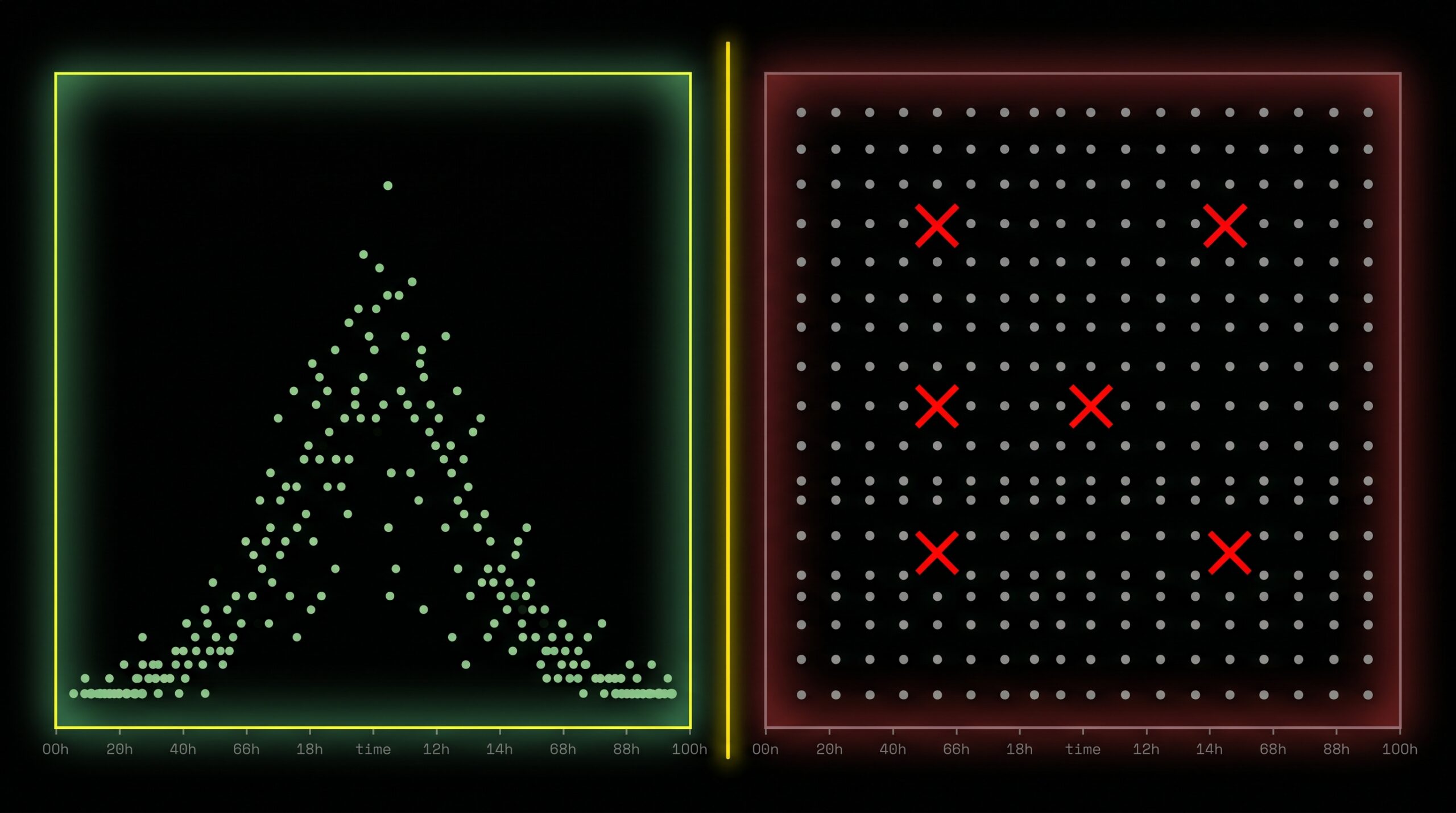
The vocabulary matters because affiliates routinely confuse the two. The canonical scrub-vs-shave distinction comes from an AffiliateFix thread that’s old enough to vote (December 26, 2012, thread #3238 — still cited because the mechanic hasn’t changed): scrub is the advertiser deduplicating against their own database, which is their prerogative because it’s their money; shave is the network silently deleting valid conversions, which is theft dressed in compliance language. When you negotiate hold periods and dispute terms in 2026, you are negotiating both, and you should price them separately. If a network can’t quote you their published scrub rate, what they’re hiding is either a high one or a variable shave.
If you’re modelling a new dating campaign at ratecard, you’re modelling 12–22% above reality on Tier-1 SOI and PPS, and the variance widens on Tier-2. The campaigns that fail at $1K/day and would have worked at $700/day fail because they were modelled at ratecard.
What breaks when you push a dating campaign past $10K/day?

Several things, all at once, and the order matters.
Offer caps land first. Most direct dating offers carry a daily cap somewhere between 200 and 2,000 leads. Networks don’t always publish the cap up front; you learn about it when the offer goes “paused” mid-day with no warning and your traffic source keeps charging. Build cap-awareness into your tracker — RedTrack, Binom, and Voluum all support per-offer cap alerts but you have to set them; nobody does it by default.
Hold extensions land second. A network that runs comfortably at NET-30 on $50K/month of your volume will quietly stretch to NET-45 or NET-60 when you push past $200K because their own cash-flow with the advertiser is on a longer cycle. Operator complaints on this through 2025-2026 dating threads are consistent and the affiliates who survive it are the ones with 60-90 days of float and a payment-history spreadsheet that lets them flag the slip on month one rather than month three.
Payment-processor exclusions land third. Specific Tier-2 GEOs — Turkey and Poland are the recurring ones — have payment-processor risk that triggers an offer-level shadowban when volume crosses a threshold the network calibrates for processor-pacification. Your CR doesn’t change but the offer “disappears” from your menu for two weeks. This is rarely communicated as a payment-processor issue, you hear “offer is being optimised.”
BR throttling lands fourth and is geography-specific. Brazilian mobile networks throttle click-tracker redirects above certain volumes; the same lander that loads in 600ms in the US can hit 1.4 seconds in São Paulo and shed a third of its conversion rate at scale. We run BR with regional infrastructure rather than a US-anchored tracker and even then we model the CR at 65–70% of the equivalent US offer.
CCPA opt-out friction lands fifth and is the newest. As of the January 1, 2026 CCPA amendments, businesses must visibly confirm opt-out processing — including Global Privacy Control signals — and sharing user data with an affiliate is treated as a “sale” unless the affiliate is a contracted service provider. For California traffic, the implication is that your network needs to be on your data-processor contract, not just on your dashboard. Most dating networks are not yet, and the fix is paperwork your AM has to escalate, not a tracking-pixel toggle.
How do I actually debug a dead postback at 2 AM?

The bad debugging workflow is to refresh the dashboard, then refresh the offer report, then refresh again. The good one is structured.
Step one: confirm the click is landing. Pull the click ID from your tracker. Hit the offer URL with the same click ID and watch the network’s incoming-click log (any network worth running on has one — if yours doesn’t, that is the problem). If the click lands but no row appears, the issue is upstream in your redirect chain. If the row appears with a different click ID, your sub_id propagation is broken — on Datify offers, that means inspecting the IP-carrying sub_id to see whether the macro substitution happened at click-time or got carried forward from a prior session.
Step two: simulate the conversion. Most networks expose a “test the postback” tool in the offer panel. Fire a test conversion with your click ID and watch your tracker’s incoming-postback log. If the network sends but your tracker doesn’t receive, the issue is in your tracker’s S2S endpoint — DNS, TLS handshake, IP allowlist, or a webhook receiver that quietly stopped responding after a deployment.
Step three: check the Meta CAPI worker. This is where most dating publishers actually lose money in 2026. RedTrack’s Meta CAPI integration is the deepest in the category and it has one failure mode that cost us a whole week last March: when an offer URL contains a # fragment — common for single-page dating landers that scroll-anchor to a registration form — the CAPI worker silently drops the conversion event without writing to the error log. Strip the fragment in your redirect template; the bug is a known operator gotcha but it remains unfixed in the public CAPI builder.
Step four: validate the EMQ score. Meta CAPI events expose an Event Match Quality score; for dating, anything under 7.0 is a soft signal that your hashed email or phone payload isn’t matching enough Meta profiles, which throttles the algorithm long before the account gets a formal warning. EMQ is the single best leading indicator we have for Meta dating accounts going sideways.
Step five: read the actual logs. Both Affise and Keitaro write incoming-postback logs that include the raw URL, the IP it came from, the time-to-response, and the response payload. If you’re not reading the logs you are guessing. Most dating-affiliate “tracker problems” we triage with publishers are caught in step five within ten minutes by someone who has read the logs before.
What does it really cost to run dating affiliate traffic in 2026?
The math affiliates publish is the visible math. The math that empties their account is the invisible math.
Visible math. Facebook CPC for Tier-1 mainstream dating sits around $0.30–0.40 in the US with a 3–5% conversion-to-confirmed-registration rate on a competent lander — call it $7–10 per confirmed reg before fraud netting. Push traffic on a competent network runs $0.015–0.025 per click and converts at 0.4–0.8% to SOI, so $2–6 per signup on paper. Native traffic on Taboola/Outbrain runs $0.50–1.20 CPC in the US dating vertical with CR of 1.5–3% to SOI, putting you at $17–40 per signup which only works for high-PPS offers.
Invisible math, in order of how badly it hurts. Account-aging cost on Facebook is the largest hidden line: a properly aged Business Manager with a clean payment history, warmed-up pixels, and a rotating creative library doesn’t get reviewed every Tuesday, and you pay either two months of slow ramp or $300–500/month to an agency that maintains BMs for you. Lander hosting is small if you use a CDN and large if you don’t — a single un-CDNed lander getting throttled in São Paulo can shed enough CR to swing a profitable campaign into a loss. Tracker subscription is $99–499/month depending on event volume, plus the engineer-hours every quarter rotating tracking domains the network or the platform flagged. Anti-detect-browser licences run $80–150/month per seat if you’re running multi-account Facebook. Creative production is the line every new affiliate underestimates: $300–1,500/month if you outsource, every spare evening if you don’t.
The float cost is the one that kills new affiliates. A campaign running $5K/day on a NET-30 network with a 30-day hold means you have $150K of spend out before the first dollar of receivables lands. Push that to NET-45 and you need $225K float. This is why dating affiliates either start small and self-fund or are venture-funded from day one; there is no middle path on the cash-flow chart.
Which Tier-1 and Tier-2 GEOs convert in 2026 — and which to skip?
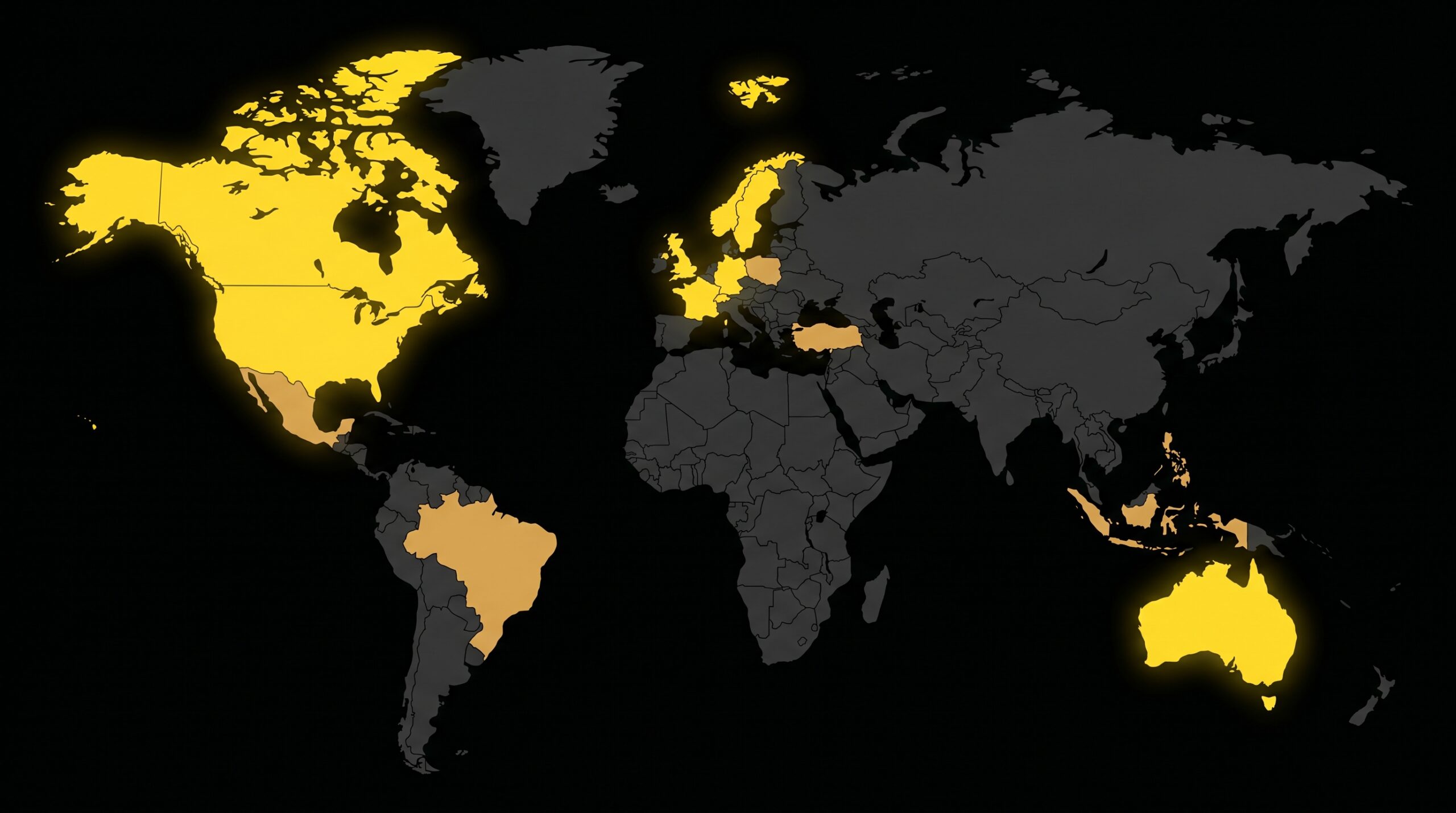
Tier-1. US, UK, Canada, Australia, Germany, France, Switzerland, Norway, Sweden. Mainstream-dating SOI at $4–7, PPS at $40–100, adult-dating PPS up to $150. Facebook still dominates net-of-aging-cost; push and in-page are competitive on volume. Tier-1 is where the realised-vs-ratecard gap is narrowest because the networks are paranoid about losing premium publishers.
Tier-2. Brazil, Mexico, Philippines, Indonesia, Turkey, Poland. SOI at $1–4, PPS at $10–40. Brazil’s Pix payment funnels have a long-tail conversion window that breaks default 7-day cookies — run BR with a 30-day attribution window and a regional tracker droplet, not a US-anchored Voluum. Mexico has a hot consumer-side query stream around dating-app safety; affiliate creative that acknowledges safety questions converts measurably better than creative that ignores them. Turkey and Poland carry payment-processor risk that triggers shadowbans at scale.
Tier-3. Bangladesh, India, Egypt, Vietnam, Pakistan. SOI at $0.30–2.00, PPS rare. Huge volume, lowest realised CR after fraud netting. This is where clustered fraud — operations running the same playbook across multiple networks simultaneously — does the most damage, precisely because the patterns that give it away only surface when you look across accounts rather than at any single one. Layered detection that combines IP, device, and behavioural signals catches what single-account checks miss; abnormally fast, mechanical interaction is one of the tells. Don’t open Tier-3 without a working fraud-scoring layer; you will be paying for traffic that the network reverses on month-end and your float will not survive it.
Which to skip in 2026. Russia is excluded by default in our offer routing — Datify does not run Russian GEO traffic for company-position reasons and most major Tier-1 networks have similar exclusions or restrictions in place. Iran, North Korea, and Cuba are sanctions-blocked for almost all networks. Beyond that, the question is fitness rather than geography: a GEO you can’t fraud-score or attribute correctly is a GEO you can’t run, regardless of what the ratecard says.
What about Meta dating-ad policy and the Privacy Sandbox aftermath?
Meta requires prior written permission to run dating ads, age 18+ targeting only, and creative restrictions that knock out adjacent entertainment, social-meetup apps that don’t match-make, and any sexually-suggestive imagery. The hardest one to get right in 2026 is the Partnership Ads designation — formerly Branded Content Ads — which is now required for any influencer or UGC dating creative; running UGC-style ads that simulate organic content without the Partnership Ads designation is classified as a “Deceptive Practice” violation, and the enforcement is automated.
The Privacy Sandbox aftermath is the larger structural shift. Google retired Topics, Protected Audience API, Attribution Reporting API, and several related services on October 17, 2025 on both Chrome and Android. UK CMA testing had previously found 85% of conversions measured by Privacy Sandbox APIs were inaccurate by 60–100%, which is why nobody is mourning the shutdown. For dating affiliates the practical implication is: your conversion stack in 2026 is Meta CAPI plus server-side postbacks plus Google Enhanced Conversions, with browser-side anything as a fallback that nobody depends on.
How do CCPA, GDPR, and consent handling change dating affiliate flows?
The CCPA January 1, 2026 amendments require visible opt-out confirmation and Global Privacy Control signal handling. Sharing user data with an affiliate “for valuable consideration” is treated as a CCPA “sale” unless the affiliate is a contracted service provider — meaning the network you run with for California traffic needs to be on a written data-processor contract, not just a self-serve dashboard relationship. This is paperwork most dating affiliates and most small networks haven’t done yet, and the path to compliance is escalation through your AM to the network’s legal team rather than a tracking-pixel toggle.
GDPR is older but the enforcement curve still steepens; cumulative GDPR fines reached €7.1bn per DLA Piper’s January 2026 survey. Dating sites are explicitly in scope for “special category data” under Article 9 when sexual orientation can be inferred. The practical implication for an EU dating affiliate is that consent strings need to be passed through the tracker, the network needs to log them, and the advertiser needs to honour them; any break in that chain creates legal exposure for whoever is left holding the data when the regulator asks.
The honest summary is that compliance for dating affiliates is no longer a back-office afterthought — it is a campaign-design constraint that determines which GEOs you can run, which traffic sources you can use, and which networks you can integrate with.
What edge cases will bite you that nobody publishes about?
Five we’ve hit in the last twelve months that are worth knowing about before they happen to you.
One: iOS-26 click-ID compression. Apple’s latest Safari builds compress the URL-passed click ID parameter on certain redirect chains, dropping characters past byte 64. If your tracker’s click ID is longer than that and you’re seeing iOS conversions arrive with truncated IDs that don’t match any click row, this is why. Fix is to compress your own click ID format before it ever hits Safari.
Two: anti-detect-browser fingerprint collisions. Multi-account Facebook publishers running anti-detect browsers occasionally hit a configuration where two of their accounts present identical device fingerprints, which Meta clusters and bans together. The accounts pass any single-account check; the collision only shows up in the cross-account view the platform sees. The takeaway is structural: any setup that reuses a device signature across accounts is one a modern detection layer is built to spot, so treat fingerprint uniqueness as a baseline assumption, not an afterthought.
Three: BR Pix attribution window. Pix-based payment funnels in Brazil convert on a longer tail than card-based ones because Pix payments resolve asynchronously through the bank. A user who clicks a dating-offer ad in São Paulo can register, abandon, return three days later, and convert through Pix; if your attribution window is the default seven days you are catching those, but if your tracker is set to one day for “performance hygiene” you are dropping a third of your BR revenue and blaming the creative.
Four: Postback timeout on Affise during reconciliation runs. During end-of-month reconciliation, the major networks’ postback endpoints get materially slower and a small percentage of legitimate postbacks time out. Your tracker logs the timeout as a failed conversion, the network’s ledger records the conversion as fired-but-not-acknowledged, and you end up with a reconciliation dispute that’s actually a tracker-timeout artifact. Raise your S2S timeout to 15s in late-month windows; cheap fix, recurring annoyance.
Five: Meta dating-permission revocation on inactive ad accounts. Meta auto-revokes dating-ad permission on Business Manager accounts that go more than 90 days without running dating creative, and the re-permission process takes 5–15 business days. If you maintain dormant BMs as backups, run a single small dating creative through each one quarterly. Sounds trivial; saves a real launch window when your primary account goes down at a bad moment.
FAQ
Q: Is dating CPA affiliate marketing worth it in 2026?
Yes, but on narrower margins than three years ago and with much higher infrastructure expectations. Global online-dating revenue is $3.24bn for 2026 with 2% CAGR — modest growth on a consolidated map. The affiliates who make money in this environment have already paid the cost of server-side measurement, fraud scoring, and aged Facebook accounts. The affiliates who treat dating as a quick-launch vertical with browser-pixel tracking and unaged Business Managers are subsidising the affiliates who didn’t. Worth it for serious operators; brutal for newcomers without infrastructure.
Q: What’s the highest-paying dating affiliate program?
On per-conversion ratecard, adult-dating PPS at CrakRevenue tops the public list — Victoria Milan at $75 PPS worldwide, with some adult-leaning offers in the $100–150 band. RevShare can beat PPS for affiliates with 6+ months of stable traffic; CrakRevenue’s published cap is 65% lifetime on adult inventory. “Highest paying” depends on whether you’re measuring the headline or the realised number; the realised gap on Tier-1 SOI/PPS sits at 12–22% below ratecard.
Q: Can you make $100 a day with dating affiliate marketing?
We do not give specific earnings forecasts and you should be sceptical of anyone who does. The structural answer: $100/day net of all costs requires either a paid-social campaign with aged accounts on Tier-1 mainstream offers or sustained push/in-page volume in Tier-2 with a working fraud-scoring layer. Both setups require the infrastructure described in this article — they are not weekend-launch outcomes. Anyone selling you a $100/day guarantee for dating in 2026 is selling you something other than dating affiliate marketing.
Q: What is the 80/20 rule in affiliate marketing?
The colloquial 80/20 in affiliate work means 80% of your revenue comes from 20% of your offers, creatives, or traffic sources. In dating specifically, our internal observation is that the concentration is even tighter — a top-tier dating publisher typically runs two or three offers, four to six creative concepts, and one or two GEOs at a time, because the operational cost of tracking and optimising more is what eats the margin.
Q: Does Tinder have an affiliate program?
No. Tinder does not have an active public affiliate program in 2026. Neither does Bumble. Match Group does not run a unified affiliate program for external CPA networks; the access path to Match Group brands is through specialist CPA networks that hold direct contracts. Any “Tinder affiliate program” landing page being marketed to you is either a smartlink with Tinder-flavoured branding or a misrepresentation.
Q: What’s the difference between PPS and RevShare for dating?
PPS pays a fixed amount when the user converts to a paid subscription (typically $40–150 in Tier-1 dating). RevShare pays you a percentage of the user’s lifetime spend on the advertiser’s product (typically 30–65% depending on offer type). PPS pays once and pays fast; RevShare pays many times and pays slowly. PPS is better for one-shot traffic; RevShare is better for sustained traffic to subscription products where you can outlast the user-cohort retention curve and collect billing-cycle two and three.
Q: How long do dating affiliate networks hold payouts?
Standard published terms are NET-30 with a 30-day hold on conversions — meaning a conversion fired today is paid out roughly 60 days from today after surviving the hold and reconciliation. Smaller and newer networks frequently extend this to NET-45 or NET-60 once your monthly volume crosses a network-specific threshold, without changing the published terms. Build a payment-history spreadsheet from day one of any new network relationship; the slip from NET-30 to NET-45 is the most common point at which under-capitalised dating affiliates run out of float.
Q: Can I run Meta dating ads as an affiliate in 2026?
Yes, with prior written permission from Meta, age 18+ targeting only, and creative that avoids sexually-suggestive imagery, dating-adjacent entertainment, and non-matchmaking meetup apps. Any influencer or UGC-style dating creative must use the Partnership Ads format; running UGC-style without that designation is classified as a Deceptive Practice violation and the enforcement is automated. The Privacy Sandbox shutdown on October 17, 2025 means Meta CAPI is now the canonical conversion path — not browser pixel — so your tracker and your offer URL chain must propagate server-side postbacks correctly or your match rate will degrade and your account will get throttled before it gets disabled.
Where to go next
If you’re new to the dating vertical, the next step is concrete: pick one network, integrate one offer, set up server-side postback testing before you spend a dollar, and run $500 of paid traffic to see whether your tracking chain holds. Most of the operational failures we triage with new publishers happen because they scaled before they verified. Our dating offers archive covers the next layer — picking specific offers, optimising landers, and managing the publisher relationship past month two.
If you’ve been running dating for a year or more, the highest-leverage thing you can do in 2026 is audit your measurement stack against the Privacy Sandbox shutdown. Read through our dating-vertical archive for the workflow patterns we use with our own publishers, and if your match rates have been declining for no obvious creative reason, the answer is almost always in your postback chain.
Sources
- Statista — Online Dating Worldwide market outlook — verified May 2026: US$3.24bn global revenue 2026, CAGR 2.03% to 2030.
- AdExchanger — Google Pulls The Plug On Topics, PAAPI, And Other Privacy Sandbox APIs — published October 17, 2025, retirement date confirmed.
- Privacy Sandbox Status Dashboard — official Google source for active vs retired services post-Oct-2025.
- Meta Transparency Center — Dating Ads policy — Meta’s primary policy URL.
- Meta Business Help Center — Best Practices for Dating Ads — Meta creative guidelines.
- AffiliateFix Thread #3238 — Why Do Advertisers Scrub Leads — December 26, 2012, canonical scrub-vs-shave operator definition.
- AffiliateFix Thread #178863 — Dating niche trends in 2025 — operator discussion including Cpamatica on AI-dating offers.
- CrakRevenue — Dating SmartLink knowledge base — verified: 251 GEOs, 300+ offers.
- CrakRevenue — Maximizing Affiliate Earnings: Best Payout Types — published September 22, 2025, PPS/RevShare economics.
- AdsEmpire — How to Choose the Best Dating Offer — published July 2022, SOI vs DOI framing.
- Privado — CCPA Compliance Playbook 2026 — January 1, 2026 changes including GPC handling.
- Tapfiliate — Affiliate Marketing Data Privacy 2026 — affiliate-context CCPA/GDPR application.