
Editorial disclosure: I run affiliate operations at Datify, an affiliate network in the dating, gambling, and nutra verticals. The traffic-source observations below come from sitting in the seat that signs off on payouts, fields advertiser complaints, and bans the fraud farms that slip through. I name specific networks our publishers use; I do not get paid by any of them to do so.
The single biggest change to dating-affiliate traffic between 2023 and now isn’t a new platform, a new format, or a new fraud pattern. It’s that you can no longer count half the conversions you generate on iOS Safari without a server-side bridge, and the platforms that used to be cheap “test on a fresh BM” sandboxes — Meta, Google, TikTok — now treat dating as a permission-gated vertical with AI-driven enforcement that will hold your account for operational behavior before a single creative is reviewed. Most “best dating traffic sources” posts walk past this and list networks ranked by stated CPC. We’re going to start from the other end: what the measurement stack has to survive in 2026, then which sources actually clear the bar, and what breaks when you try to scale each one.
What counts as a dating traffic source in 2026, and why the list is shorter than it looks
A dating traffic source is anywhere you can buy or earn impressions that legitimately convert to a registration, install, or paid action on a dating offer — without getting the publisher account banned, the conversion stripped at the network’s pre-postback fraud layer, or the advertiser’s CAPI signal degraded to the point where the platform stops scaling the campaign. By that definition, the 2026 list is shorter than the 2022 list, because three classes of source aged out: untargeted display arbitrage (lost to display-network policy tightening and dating-specific prelander rejection), Tier-3 desktop pop arbitrage on stale subscriber lists (CR collapse + bot share over 60%), and Facebook traffic on un-aged Business Managers (Meta’s 2026 proactive-risk model bans these inside the first 48 hours regardless of creative quality).
What’s left splits into three reliability tiers. Tier 1 is paid social with a compliance gate — Meta, Google, TikTok. Tier 2 is direct ad networks where the compliance bar is lower and the fraud risk is higher — push, in-page push, popunder, native, in-app. Tier 3 is organic and hybrid — Reddit, Quora, YouTube content, SEO, solo email. Each tier has its own measurement assumption: Tier 1 requires CAPI / Events API / Enhanced Conversions to survive iOS Safari attrition; Tier 2 requires S2S postback wiring with a tracker that won’t silently drop events on URL fragments or batched conversion windows; Tier 3 requires you to actually own the relationship that drives the click, because attribution on organic-to-affiliate paths is structurally noisy.
Why does measurement come before the traffic-source list in any honest 2026 playbook?
Because the platform doesn’t matter much if you can’t count the conversions. Three things converged in late 2025 to change what “tracking works” means, and any dating-traffic discussion that skips them is selling the 2022 playbook.
The first is iOS 26’s Link Tracking Protection moving out of private-only mode and into all Safari sessions. Per Louder’s Sept 5, 2025 analysis of the iOS 26 beta and the WITHIN advertiser-side breakdown, Safari now strips fbclid, gclid, dclid and similar click identifiers from URLs at navigation time across normal browsing, not just incognito. Aggregate identifiers like wbraid and gBraid survive, which is why Google’s privacy-safe params kept working when Meta’s fbclid did not. If you were relying on gclid or fbclid round-tripping through your tracker to attribute the conversion, your iOS Safari attribution rate dropped sharply the moment Apple ramped iOS 26 through Q4 2025.

The second is the Privacy Sandbox shutdown. Search Engine Land’s Oct 20, 2025 coverage confirms Google retired Topics, Protected Audience, and Attribution Reporting APIs after years of testing. Third-party cookies remain enabled in Chrome by default. That is the entire surviving win — and it does nothing for the iOS Safari and Firefox traffic that just lost its click IDs. Anyone who built a 2024–2025 measurement plan around Sandbox APIs now has dead infrastructure to rip out.
The third is the move to AI-driven enforcement on Meta. Audit Socials’ 2026 Meta policy tracker catalogues the shift to proactive risk assessment — accounts are disabled for operational behavior flagged as high-risk, not just confirmed policy violations. For dating accounts this means a fresh Business Manager with a clean payment method, no pixel history, and a recently-uploaded creative library trips the AI risk model independent of whether the offer or creative ever violated a written policy.
The practical implication is that every dating traffic source in 2026 has a CAPI-equivalent that you need wired before you scale. Meta needs CAPI. TikTok needs Events API. Google needs Enhanced Conversions. Push, native, and pop networks need S2S postbacks, properly wired through a tracker that handles iOS click-ID strip gracefully. Without that layer, the publisher pays for the click and the network never sees the conversion — and the postback fight that follows is one I sit through every week.
Meta Ads: still the cheapest Tier-1 dating CPC, if the account lives
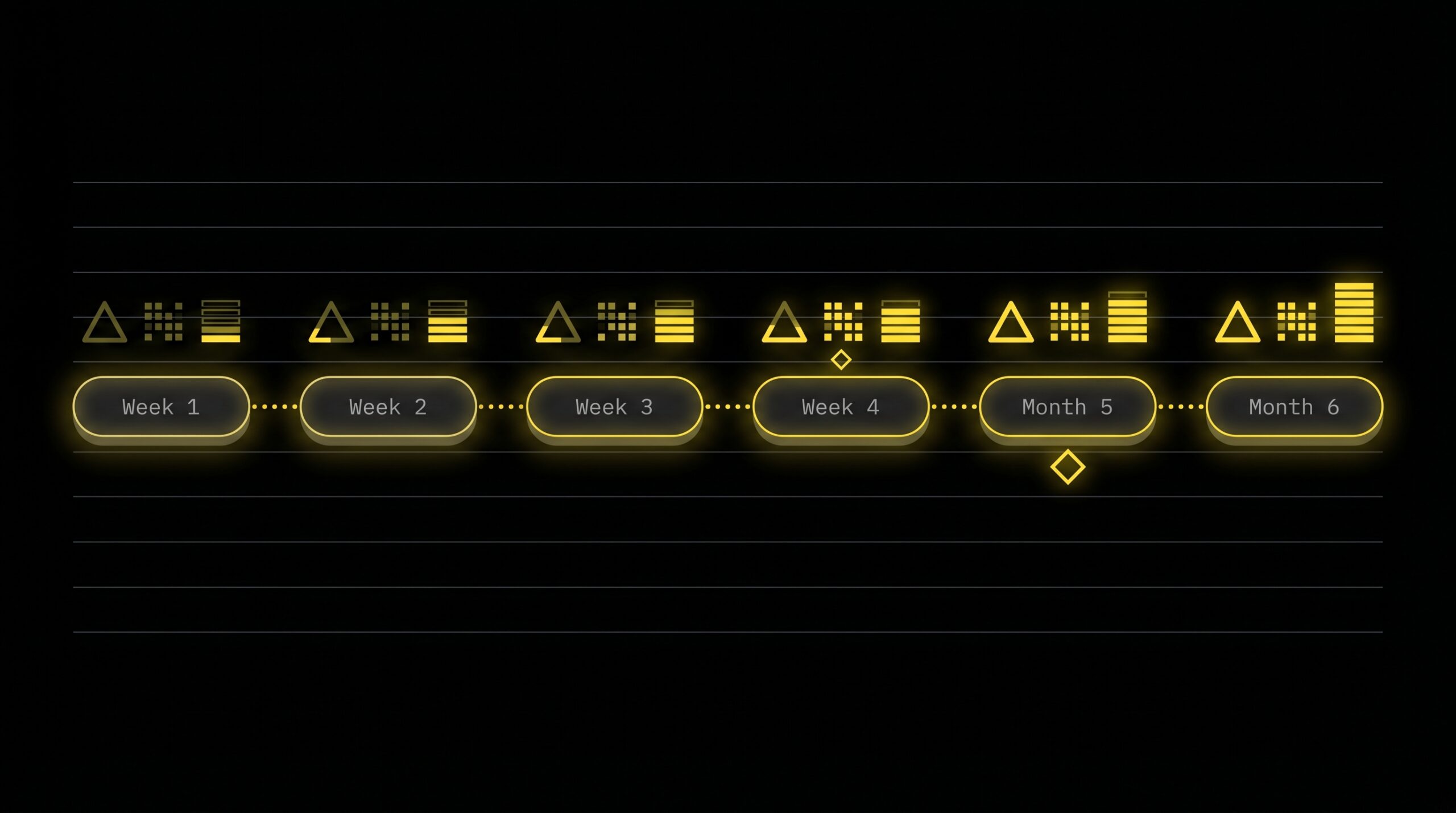
Facebook and Instagram remain the cheapest Tier-1 dating traffic per converted registration if you can stay on the platform — and that “if” is doing all the work. Our publishers running mainstream-dating SOI on US Facebook average roughly a $0.32 CPC and a 4.1% CR to email-confirmed registration on aged Business Managers. The same publisher running the same offer on push pays around $0.018 per click and converts at 0.6%, which is $3.00 per reg on paper but closer to $4.20 after we strip bot signups at the network’s fraud layer. The reason Meta still wins net-of-everything is account longevity: a properly aged BM with a clean payment history, warmed-up pixels, and a rotating creative library doesn’t get reviewed every Tuesday. The cost of Meta isn’t the CPC. It’s the two months you spent aging the assets and the $400/mo agency fee for the BM provider.
What Meta’s own dating ads policy makes formal: ads require prior written permission from Meta before a single dating campaign runs, must target users 18+ only, and cannot emphasize casual sexual encounters, monetary or financial arrangements (sugar dating, mail-order bride), affairs, non-monogamous connections, or fake-profile-driven flows.
What breaks at scale on Meta in 2026 from where I sit:
- Account longevity reset on payment-method change. A publisher swaps the card on a 6-month BM because the old one expires, and the AI risk model reweights the account inside 24 hours. CTR drops 20–35% on identical creative, the publisher panics, throws fresh creative at it, and the account is restricted by end of week.
- Pixel quality degradation after pauses. Pixels that go dark for 14+ days come back with measurably worse lookalike quality.
- CAPI silent drops on URLs with
#fragments. Single-page dating landers that scroll-anchor to a registration form put a#anchorin the offer URL. The Meta CAPI worker in several tracker integrations drops the conversion event when the URL has a fragment. - Operational-risk holds before a single conversion. Fresh BMs running clean creative get held for “high-risk operational behavior” because the account’s behavioral signature trips the proactive-risk model. The fix is BM aging, not creative tweaks.
The publisher economics math that survives all of the above: $0.32 CPC × 4.1% CR = $7.80 per confirmed reg. Add all-in costs — BM agency fee, CAPI bridge subscription ($99–$300/mo), creative rotation — and the realised cost per reg sits closer to $9.50–$11.00. That still beats every other Tier-1 source net of everything.
Google Ads: viable again after the August 2025 policy expansion
Google’s Dating and Companionship policy update published in August 2025 narrowed the country prohibition list down to 17 named MENA and South Asia GEOs — Algeria, Bahrain, Sri Lanka, Palestine, Iraq, Jordan, Kuwait, Lebanon, Libya, Morocco, Oman, Nepal, Pakistan, Qatar, Saudi Arabia, Tunisia, Egypt, Yemen. Outside that list, dating ads can run subject to certification. Publishers who’d written Google off for mainstream dating in 2023 should re-evaluate; the inventory unlock is meaningful.
What breaks at scale on Google in 2026:
- Certification limbo. Accounts in pending certification cannot run any dating creative, even on offers that were running clean before the policy change forced re-certification.
- Performance Max placement drift. PMax for dating has a 3–4× higher ban-rate than Search and YouTube In-Stream campaigns for the same offer.
- Display Network sugar-dating auto-flag. Google’s classifier interprets innocuous dating creative as compensated companionship if certain image-recognition triggers fire.
- iOS Safari attribution collapse without Enhanced Conversions. Publishers running Google traffic without Enhanced Conversions wired lose the ability to count and bid on roughly the iOS Safari share of their traffic — which on Tier-1 dating is rarely under 25%.
TikTok Ads and Spark Ads: where the creative bar replaces the targeting bar
TikTok dominates Tier-1 and Tier-2 Gen-Z dating reach in 2026, and Spark Ads has the best CTR-to-CPM ratio for mainstream dating creative because the post inherits algorithmic trust from the original organic distribution. Dating-app ads are not allowed in 15 named markets per TikTok’s other products and services policy — Algeria, Bahrain, Bangladesh, Egypt, Iraq, Jordan, Kuwait, Lebanon, Morocco, Oman, Pakistan, Qatar, Saudi Arabia, Turkey, UAE.
What breaks at scale on TikTok in 2026:
- Compliance review variance across BMs. The same creative gets approved on one Business Manager and rejected on another. Operators need 2–3 redundant BMs to keep ads flowing during 2026’s review queue surges.
- Affiliate-link disclosure detection on Spark Ads. TikTok’s automated check flags videos that include affiliate links without disclosure.
- Creator commission stacking. Spark Ads typically run 10–30% gross-revenue share to the creator on top of media cost.
What about push, in-page push, and popunder networks?
Push, in-page push, and popunder networks are where most dating affiliates outside Tier-1 paid social actually spend money, and where most fraud disputes I handle originate. Tier-3 GEO push CPC starts at $0.0001; Tier-2 (Eastern Europe, Southeast Asia) ranges $0.005–$0.02; Tier-1 dating push CPC runs $0.01–$0.10. Network roster on operator-recommended dating push: PropellerAds, RichAds, EvaDav, Adsterra, MyBid for push and in-page push; PopAds and Zeropark for popunder.
The hidden cost: there’s a $500–$1,000 minimum testing budget per network to gather statistically meaningful data on whitelists and blacklists. Treat the test budget as a fixed setup cost, not as media spend.
What breaks at scale on push and pop networks:
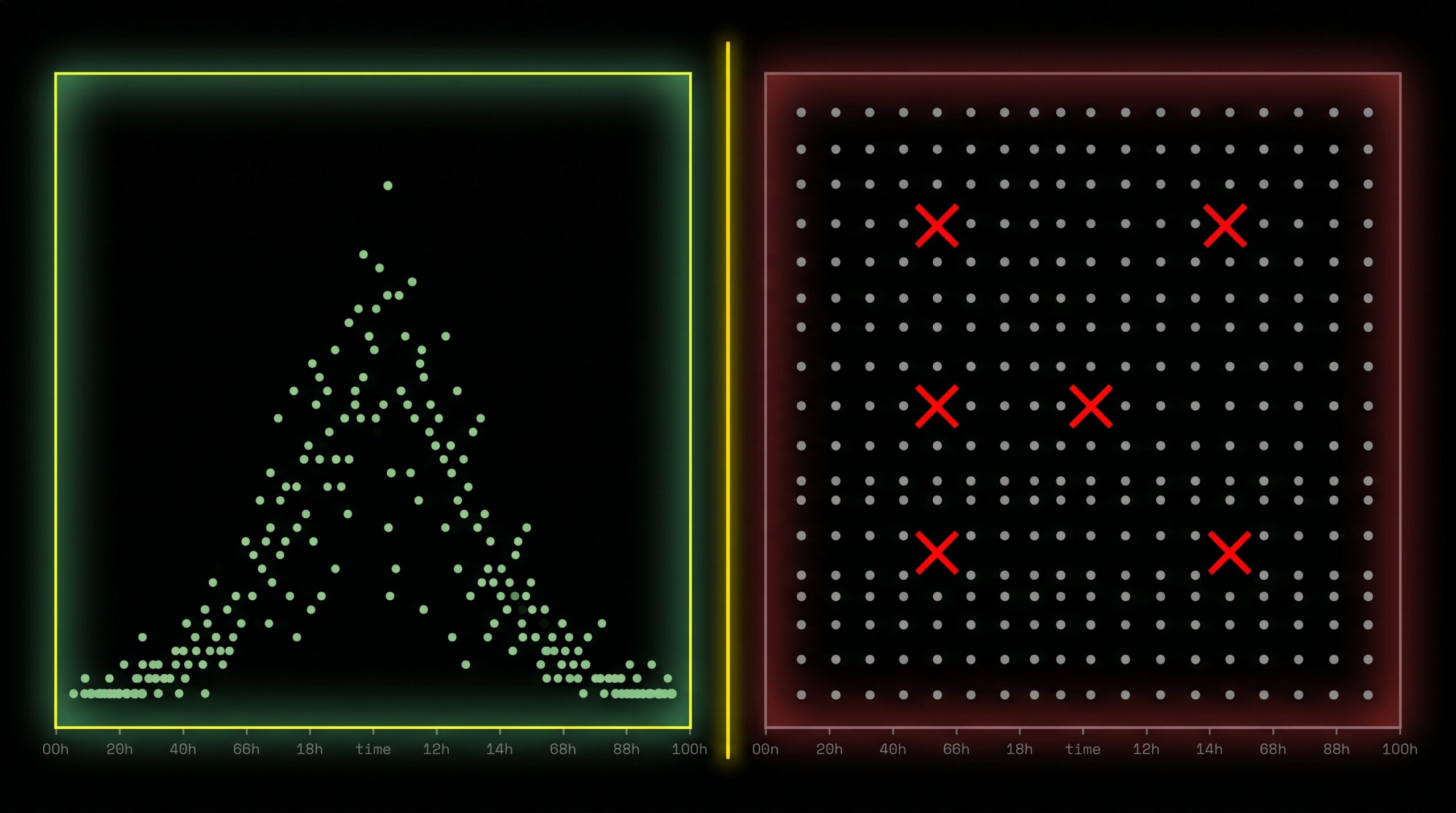
- CTR fraud quarterly. Push CTR fraud spikes roughly once per quarter on the larger networks. The symptom: a publisher’s payout request triples with effectively zero conversions backing it up, and the pre-postback fraud filter catches a CTR pattern (uniform inter-click intervals, identical user agents on geo-spread IPs).
- Subscriber list freshness decay. CR on the same offer + same network can drop 30–50% over six months without anything else changing.
- Bot-farm signups on cheap GEOs. Tier-3 push GEOs (BD, IN, PH) carry higher bot-signup rates. Last quarter we banned four BD-based farms that every single conversion fired the lander’s form-focus event under 2 seconds after page-load.
- Anti-fraud tracker subscription as a hidden line item. Standalone anti-fraud (Adspect, FraudScore, IPQS) runs $100–$500/mo.
Native ads: where the prelander does most of the work
Native networks — Taboola, Outbrain, MGID, Revcontent — sit between paid social and push on both compliance and unit cost. Tier-1 dating native CPCs run $0.20–$0.60 (Taboola at the higher end, Outbrain $0.20–$0.50, MGID 30–50% lower). The structural difference from other paid sources is that native works almost entirely on advertorial-style prelanders. You need 3–8 prelander variants per offer to find a winner, at $200–$800 each in production cost.
In-app ad networks: where SKAdNetwork still eats your bid signal
In-app traffic (Unity Ads, AppLovin, ironSource) is the primary install channel for mobile-first dating apps. iOS CPI averages $5.84 in Q1 2026, up 19% year-over-year; Android CPI runs $1.92, up 8%. The 24-hour SKAdNetwork aggregation window means real-time bid optimisation runs on stale data, and ATT opt-in cap below 25% means deterministic attribution on iOS is structurally low.
Organic and hybrid sources: Reddit, Quora, YouTube, SEO, email
Organic and hybrid traffic for dating affiliates in 2026 is less about volume and more about owning a relationship the platform can’t strip from you on an enforcement update. Reddit’s Contributor Quality Score system flags spammer-pattern accounts. Quora’s persistence advantage — answers stay searchable for years — makes the unit economics better than Reddit for direct response. SEO is a 12–18 month investment complementary to paid traffic, not a replacement.
How do you decide which traffic source to start on?
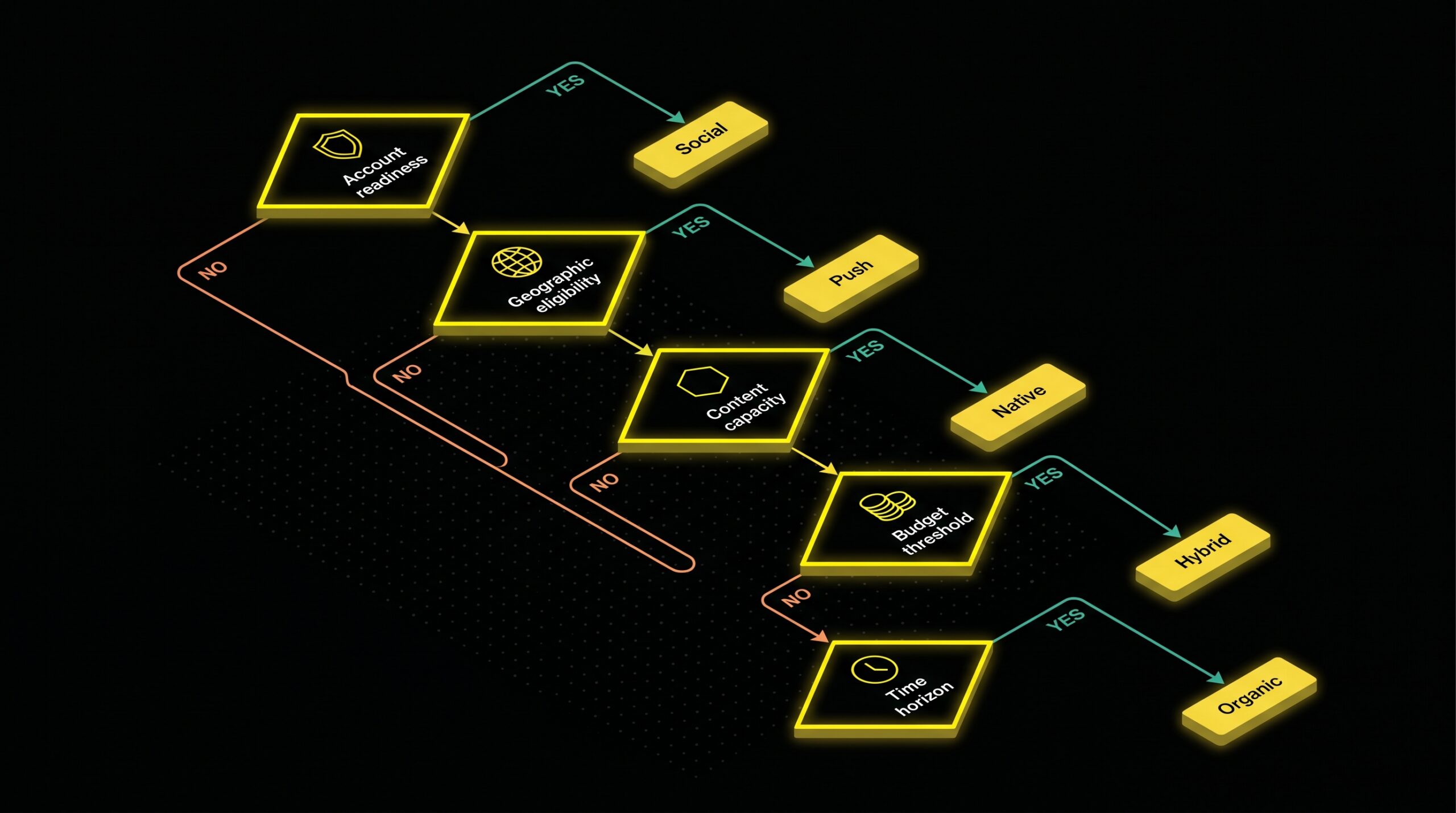
The decision tree that survives contact with reality, in order:
- Do you have a clean aged Business Manager and a CAPI bridge already running? If yes, Meta is the default first source. If no, BM aging and CAPI setup is a 6–8 week project.
- Are you operating in one of the 17 Google-prohibited dating GEOs? If yes, Google is closed for you. If no, Google Search and YouTube In-Stream are viable on certified accounts.
- Do you have an in-house UGC operation or vetted creator roster? If yes, TikTok Spark Ads is a strong second source.
- Do you have $500–$1,000 of patience-budget for whitelist development? If yes, push and native become viable.
- Do you have 6+ months of community time to invest before the first conversion? If yes, organic Reddit and Quora compound.
Most Datify publishers running mainstream dating profitably in 2026 run two or three of the sources above in parallel, not all of them. Concentration in two sources where the unit economics work is structurally more profitable than spreading thin across five sources where none of them clear the cost ceiling.
Frequently asked questions
Q: What’s the best traffic source for dating affiliate offers in 2026?
A: For Tier-1 GEOs and mainstream dating offers, Meta Ads on an aged Business Manager with CAPI wired through a tracker is still the cheapest net-of-everything source, despite higher headline CPCs than push. For Tier-2 and Tier-3 GEOs, push networks (PropellerAds, RichAds, EvaDav) and native (MGID, Outbrain) are where most volume happens.
Q: Why does Meta require permission for dating ads now?
A: Meta moved dating from “restricted” to “permission-gated” because the vertical was the source of disproportionate consumer complaints. The 2026 enforcement layer now also disables accounts for operational behavior flagged as high-risk before any creative is reviewed.
Q: Which push networks work best for dating in 2026?
A: PropellerAds, RichAds, EvaDav, Adsterra, and MyBid are the operator-recommended push and in-page push networks for dating, with PopAds and Zeropark dominant on popunder.
Q: How does iOS 26 affect dating affiliate tracking?
A: iOS 26’s Link Tracking Protection strips fbclid, gclid, dclid and similar click identifiers from URLs across all Safari browsing modes. The mitigation is server-side: Meta CAPI, TikTok Events API, Google Enhanced Conversions, and S2S postbacks through a tracker that handles iOS click-ID strip gracefully.
Q: Are dating ads still allowed on Google Ads in 2026?
A: Yes, outside the 17-country prohibition list. Google’s August 2025 policy update actually narrowed the prohibition list — markets that had been Google-blocked for years reopened. Certification is required.
Q: What’s the typical CPC for dating ads on TikTok in 2026?
A: TikTok dating CPCs run roughly $0.40–$1.20 for Tier-1 mainstream dating with Spark Ads on aged BMs, lower in Tier-2 GEOs. The bigger cost component is creative production.
Q: How much budget do I need to test a new push traffic source?
A: $500–$1,000 in media minimum. The all-in cold-start budget for a serious new-source test runs $2,000–$6,000.
Sources
- Meta Transparency Center — Dating Ads Standards
- Google Ads Help — Dating and Companionship policy (August 2025 update)
- Search Engine Land — Google officially shuts down Privacy Sandbox
- Louder — iOS 26 ends click IDs
- WITHIN — iOS 26 Link Tracking Protection Explained
- TikTok — Other products and services advertising policies
- Audit Socials — Meta Ad Policy 2026 Update Tracker
- AffTank — 15 Best Push Notification Ad Networks 2026
- RichAds — Best Dating ad networks for affiliate marketers in 2026
- affLIFT — $66,500 Profit on Dating Offers with Push Notifications