
SEO for affiliate marketing in 2026 is the practice of building search-driven affiliate funnels that survive Google’s post-Helpful-Content reality — where 71% of affiliate sites lost rankings in the March 2026 core update and the only inventory that recovered demonstrated provable first-hand experience, real product usage, and identifiable authors with skin in the game. The operator playbook has compressed: fewer pages, deeper expertise per page, programmatic-SEO at scale only with original data, and link budgets that now realistically start at $300 per editorial placement on a DR-50+ domain.
Editorial disclosure: Datify operates an affiliate network for dating offers, and our publishers run the full media-buying spectrum — paid social, push, native, and content-SEO funnels. The content-SEO publishers in our top-100 are the ones who taught us most of what’s in this article, usually after losing 30–80% of their organic traffic to a Google update and rebuilding. We do not earn commissions from the SEO tools or link vendors named here.
Key takeaways
- Affiliate SEO is now a survival sport. Affiliate sites saw a 71% negative-impact rate in Google’s March 2026 core update per ALM Corp’s analysis, the worst of any content category. The pages hit hardest are templated “best X” lists, AI-generated roundups, and reviews that don’t reflect real product usage.
- EEAT is no longer marketing theatre — it’s the gate. Google’s own thin-affiliate guidance calls out copied product descriptions and “cookie-cutter” templated sites as policy violations, not just low-quality content. We watch publishers fail here every week during onboarding compliance review.
- Link economics broke. Average cost of a niche-edit backlink is now $361.44 and a DR-50+ editorial placement runs ~$600 per Ahrefs’ 2026 industry survey, via editorial.link’s compilation. Content-only SEO without a link budget is a 12–18 month bet for new domains.
- Programmatic SEO survived but narrowed. It works at scale only when each page carries a unique data point that nobody else can copy — pricing pulled from your tracker, conversion data from your network, GEO benchmarks from your dashboard. Templated comparison-page farms are the exact thing the March 2026 update killed.
- AI Overviews ate the top of the funnel. Informational queries that used to send traffic to “what is” affiliate-content pages now resolve in the SERP. The funnel that still pays is mid-to-bottom commercial-intent — comparisons with real-usage data, GEO-specific guides with operator numbers, and tool reviews with screenshots from a working account.
Table of contents
- What does “affiliate SEO” actually mean in 2026?
- Why did 71% of affiliate sites lose rankings in March 2026?
- How do you actually demonstrate EEAT on an affiliate site?
- What breaks when programmatic SEO crosses 5,000 URLs?
- How do I debug an affiliate site that just lost half its traffic?
- What does affiliate-content SEO actually cost in 2026?
- Which edge cases will bite you that competitors don’t write about?
- How should I structure a new affiliate site I’m starting in 2026?
- FAQ
What does “affiliate SEO” actually mean in 2026?
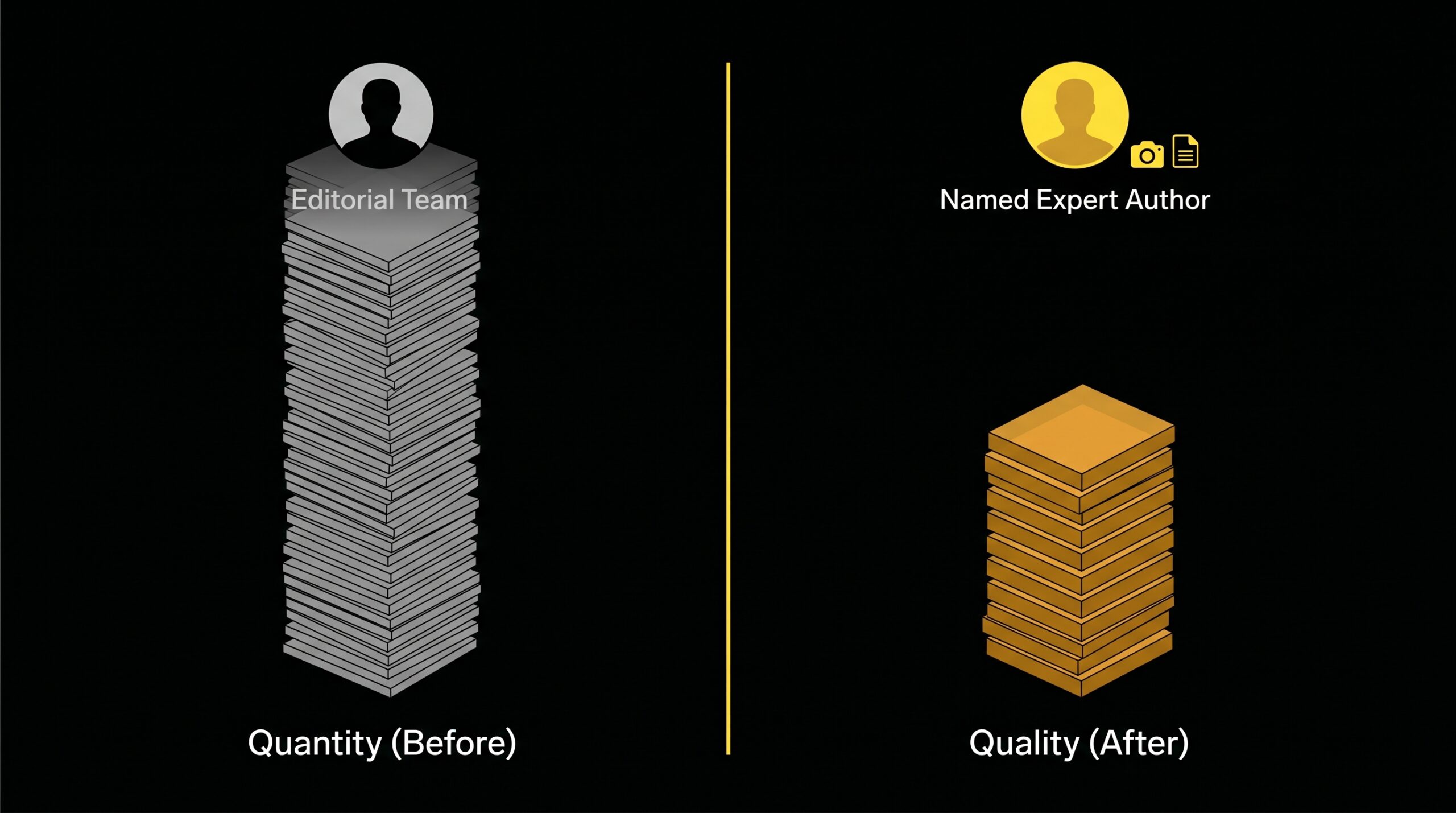
The term used to be unambiguous: build a niche site, target buyer-intent keywords, rank reviews and “best of” lists, monetise with affiliate links. That definition still gets you a working content site in 2018. In 2026 the same playbook gets you penalised inside a quarter, because every part of the chain — keyword research, content production, link acquisition, on-page templating — has been industrialised, AI-generated, and then specifically targeted by Google’s spam team for a year of consecutive updates.
What I work on with our publishers now is narrower and more boring. Affiliate SEO in 2026 is the production of search-discoverable content that a real human with operational experience would have written anyway, because they had something to say. The “anyway” is doing the work. If you can’t articulate what you’d publish without the affiliate angle — your real expertise, your real data, your real receipts — Google’s quality systems will eventually figure it out, and the recovery cycle from a manual or algorithmic hit is now 6–18 months in our publishers’ experience, not the 6–8 weeks it was in 2021.
The shape of a 2026 affiliate-SEO site that survives looks like this: 30–80 pages, not 3,000; a named author with a verifiable track record (not “Editorial Team”); original photographs of the products in use; a measurable opinion in the first 200 words (“we use X for our Tier-2 push campaigns specifically because Y”); and a link-budget acknowledgement that the first 12 months will be expensive and the second 12 months will be cheaper because authority compounds.
This is not the article that will please you if you came looking for an exhaustive scaling playbook on programmatic affiliate SEO. That playbook is what I’m telling you Google killed.
Why did 71% of affiliate sites lose rankings in March 2026?
The March 2026 core update was the third in a sequence that started with the Helpful Content Update (HCU) in 2022 and continued through the December 2025 core update. Each pass tightened the same screw: Google’s quality systems became progressively better at identifying content that exists primarily to monetise search traffic rather than to serve a query.
The headline number — 71% of affiliate sites experiencing ranking drops per ALM Corp’s analysis of the March 2026 update — is dramatic but understates the bimodal distribution we see in our publisher data. The sites that lost ranking lost a lot. The sites that survived didn’t move much. There’s almost no middle ground.
What got penalised
Three patterns dominate the damaged-site cohort I’ve reviewed during compliance check-ins this quarter:
- Templated “best X” listicles where the author has clearly never used the products. The tell is in the writing voice. A real user of a tracker mentions the postback latency, the dashboard quirks, the support ticket they had open last quarter. A templated roundup mentions the marketing-page bullet points: “robust integrations, intuitive dashboard, scalable pricing.” Google’s classifiers got very good at distinguishing these in 2025.
- AI-spun expansion content. Sites that went from 50 pages to 5,000 pages between July 2024 and February 2026 by feeding GPT-4 a keyword list and a template. There were entire affiliate networks running this play; most are gone from the SERP now. The WebmasterWorld threads on the December 2025 update are full of operators sharing GA screenshots of 95% drops on sites that had been compounding for years before the AI expansion.
- Cookie-cutter network sites with shared content templates. Google’s own thin-affiliate spam guidance explicitly names this: “affiliate pages can be considered thin if they are part of a program that distributes its content across a network of affiliates without providing additional value.” A few of our larger publishers operate page-template networks across 8–15 domains, and the ones that didn’t customise per-domain got flattened.
What survived
The cohort that didn’t lose ranking shares unsexy traits: lower content volume, named authors with social/LinkedIn footprints that match their bylines, original imagery, comment sections that suggest actual readership, and — critically — measurable signals of first-hand product experience. The third-party data on this is converging from multiple angles: Automattic’s affiliate SEO recovery guide frames it as “demonstrating real product experience over time”; Hobo Web’s HCU retrospective frames it as “first-hand experience and expertise on the topic.” Different framings, identical signal.
The publishers in our network who didn’t lose traffic in March 2026 had been writing fewer, deeper pages for two years already. The publishers who did lose traffic had been hiring offshore content teams to expand to thousands of templated pages. The market consolidated overnight; the trajectory of who would win was visible 18 months in advance.
How do you actually demonstrate EEAT on an affiliate site?
EEAT (Experience, Expertise, Authoritativeness, Trustworthiness) is the framework Google’s quality raters use, not a ranking factor in the technical sense. But the on-page signals that EEAT depends on — author identity, original content, demonstrated usage — feed several real ranking systems. So the practical question becomes: what can you put on a page that meaningfully signals these things?
I’ll list the signals our compliance-review process actually checks for when we onboard a new content publisher to Datify, because if we won’t accept a publisher whose site fails these checks, you can assume Google is at minimum applying the same scrutiny.
Author identity that survives a click-through
Your author byline needs to lead somewhere. A 2026 EEAT-credible author page contains a real photograph (not a stock headshot or AI generation), a verifiable employment history, links to the same person’s LinkedIn or industry-conference talks, and an article archive that demonstrates topical consistency. We reject publisher applications about three times a month where the listed author is provably someone different from the person sending the application emails — usually because the publisher bought a “complete affiliate site” from a marketplace and inherited a fake-author setup.
Our affiliate-management team’s impression, not a formal export: roughly one in three content-publisher applications coming in over the past few quarters has failed first-pass author-identity checks — usually because the listed author profile cannot be matched to the person sending the application emails. The pattern is consistent enough that author-verification is now the first compliance question we ask before any payout setup.
Original product usage evidence
A review of a tracker should contain a screenshot from the reviewer’s actual dashboard. A review of a payment processor should reference their merchant-account experience. A review of an offer network should mention the offer-ID and date range they ran. The specific is doing the EEAT work; the abstract isn’t.
This is also where most templated affiliate sites fall apart. Generating original screenshots, pricing snapshots, and dashboard captures at scale doesn’t compose well with the “spin 200 articles per month” model that worked in 2021. The economics force you into either narrower scope or a much larger production budget.
Schema, citations, and the boring trust layer
Article schema with a real author and reviewer field. Outbound citations to primary sources — manufacturer pages, official documentation, regulatory filings, peer-reviewed research where applicable. A genuine Last updated date that actually reflects when the page changed. None of these are individually decisive, but their absence in 2026 is correlated with the cohort that lost traffic.
Note specifically: the dating vertical adds an EEAT wrinkle most general-SEO advice misses. Google’s quality raters are explicitly cautious about adult-adjacent content, and an EEAT-credible dating-affiliate site needs to lean harder on demonstrable expertise than, say, a kitchen-equipment review site. We’ve internally flagged this as the reason dating-app-review keywords are particularly hostile to new domains: the bar is higher for trust signals.
What breaks when programmatic SEO crosses 5,000 URLs?
Programmatic SEO — generating hundreds or thousands of pages from a structured data source plus a template — is one of the few content-production patterns that didn’t get categorically killed in 2025–2026. But the failure modes are specific, and most of them only become visible at the 5,000-URL mark, where I’ve watched publishers in our network hit walls.
Failure mode 1: index-bloat decay
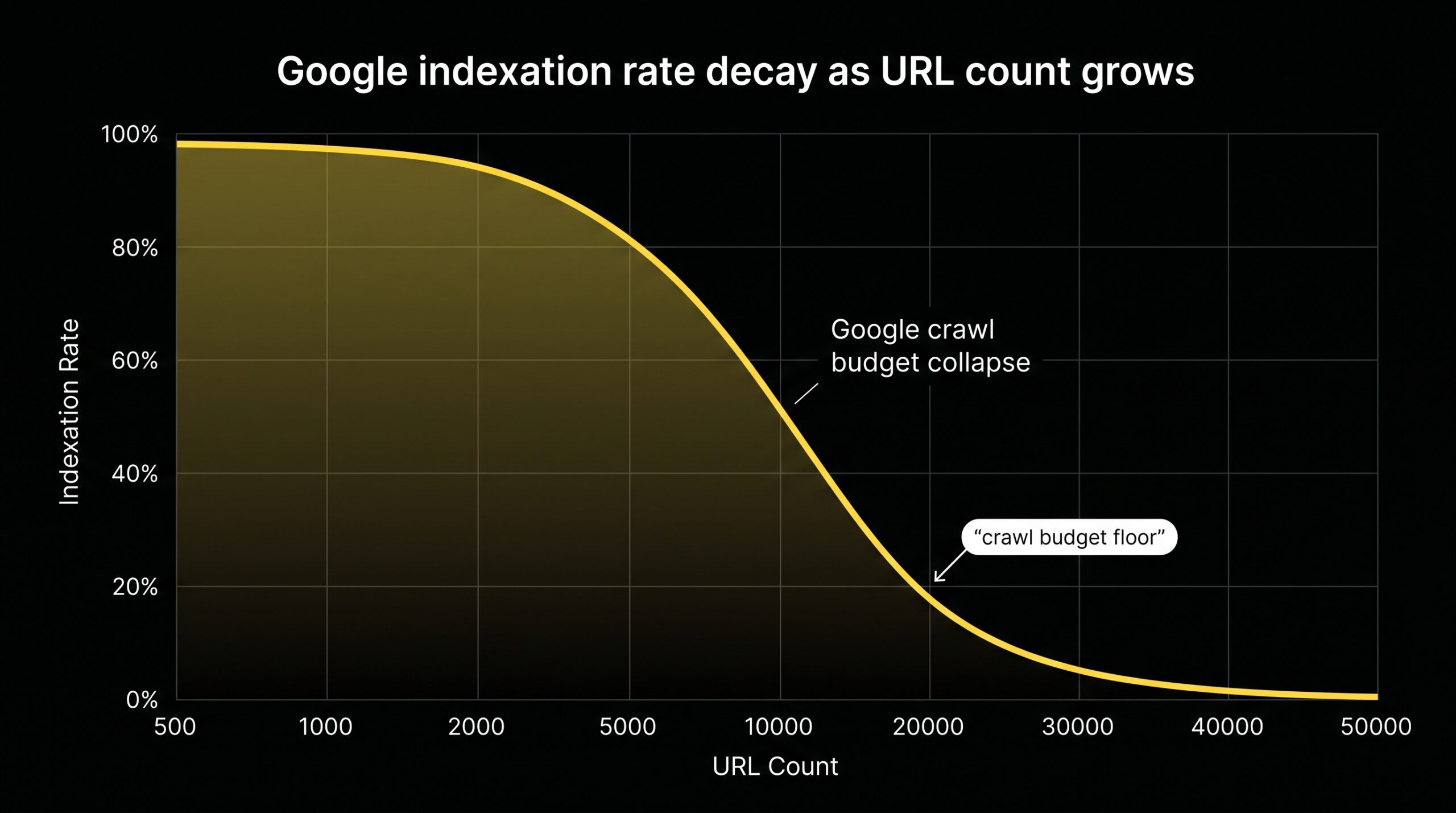
Google will index your first 500 programmatic pages enthusiastically. By URL 5,000 the indexation rate drops to 30–50% in our publishers’ Search Console exports. By URL 50,000 you’re looking at single-digit indexation unless there’s a manual XML-sitemap ping cadence and the pages individually carry signals worth indexing.
The diagnostic is to bucket your URL set into cohorts of 1,000 by publication date, then look at GSC’s Indexed vs Discovered – currently not indexed ratio per cohort. The decay shape — strong indexation on the first 1k, weakening on the next 4k, falling off a cliff thereafter — is the canonical “Google decided this site doesn’t deserve index budget” pattern.
Failure mode 2: thin-content classifier escalation
A programmatic site at 200 pages can hide thin-content patterns under the variance of the small dataset. At 5,000 pages, the templating pattern becomes obvious to Google’s classifiers. We’ve watched two publishers in our network hit this wall: month-over-month organic traffic growth flatlined around the 5k-URL mark, then within 30–60 days slipped into decline as the classifier started downweighting the entire domain.
The fix is brutal and the publishers who do it successfully share a profile: they accept a 70–90% URL pruning, keep only the pages with measurable engagement, and start over with denser per-page content. The publishers who don’t prune usually disappear from the SERP within two updates.
Failure mode 3: data-source quality decay
Programmatic SEO is only as good as its underlying data. A pages-per-city template on stale Census data, a pages-per-product template on outdated pricing, a pages-per-GEO template on year-old conversion benchmarks — these all looked fine on launch and rot over six to twelve months. The hidden cost of programmatic SEO at scale isn’t the initial generation; it’s the data-refresh pipeline you have to operate forever.
This is the dimension where having unique operational data matters most. Our publishers who run programmatic-SEO content for the dating vertical pull GEO conversion data from their own tracker (Voluum, RedTrack, Binom, ClickFlare — see our tracker comparisons), refresh weekly, and surface “current 30-day CR” in the page body. Nobody else can copy this. That’s the only programmatic moat that holds up.
How do I debug an affiliate site that just lost half its traffic?
This section is the one our publishers most frequently ask me to walk them through, usually within 48 hours of a Google update rolling out. The diagnostic process is unglamorous and largely deterministic.
Step 1: confirm the loss is algorithmic, not technical
Before you build a recovery story around a Google update, rule out the boring failure modes. Check Search Console for: a recent indexing drop across categories of pages (suggests a robots.txt regression), a server-side error spike (5xx rate in Crawl Stats), a sitemap submission failure, or an HTTPS / canonical regression after a recent deploy. About 1 in 4 “Google killed my site” tickets we see from publishers turns out to be a self-inflicted technical wound that landed within the same 48-hour window as the update and got misattributed.
Step 2: segment the loss by query type
Pull the GSC Performance report, segment by query type, and compare the four-week period before the update to the four-week period after. The typical post-HCU loss pattern: informational queries (head-of-funnel “what is” queries) lose more than commercial queries (mid-funnel “best X for Y”) which lose more than navigational queries (your brand name). If your loss profile inverts that — heavier on commercial than informational — you’re more likely facing a thin-affiliate spam-policy hit than a generic core update, and the recovery path is different.
Step 3: identify the page cohort that lost most
Sort GSC clicks-lost data by URL. The damaged cohort is rarely uniform. Usually there are three buckets: pages that lost almost everything (your templated, low-experience cohort — these need to be rewritten or removed), pages that lost moderately (your weaker reviews — strengthen with original usage signals), and pages that didn’t lose much or actually gained (your authentic-experience cohort — this is your recovery anchor; double down here).
The mistake I see most often is publishers spreading recovery effort uniformly across the site. The damaged cohort needs to either be rewritten with materially better content or deleted. Half-measures (adding 200 words, rotating a few synonyms) don’t move the needle and have eaten months of recovery time for several of our publishers before they accepted the diagnosis.
Step 4: rebuild EEAT signals on the survivors
The pages that didn’t lose ranking are your foundation. Audit each one for: author byline pointing to a real person, original imagery (not stock or AI-generated), at least one citation to a primary source, and at least one specific operational detail (a price, a dashboard screenshot, a date-stamped experience). These are the pages Google will re-evaluate fastest in the next core update; the goal is to make them irrefutably high-quality so the recovery signal travels back to the rewritten pages.
Recovery in our publishers’ actual experience: 4–9 months from the bottom of the loss to a meaningful rebound, contingent on a subsequent core update rolling out. There’s no in-between mechanism. Google does not gradually re-evaluate; it re-evaluates in waves. If you’ve fixed the underlying issues but a core update hasn’t rolled out since, you’re waiting.
What does affiliate-content SEO actually cost in 2026?
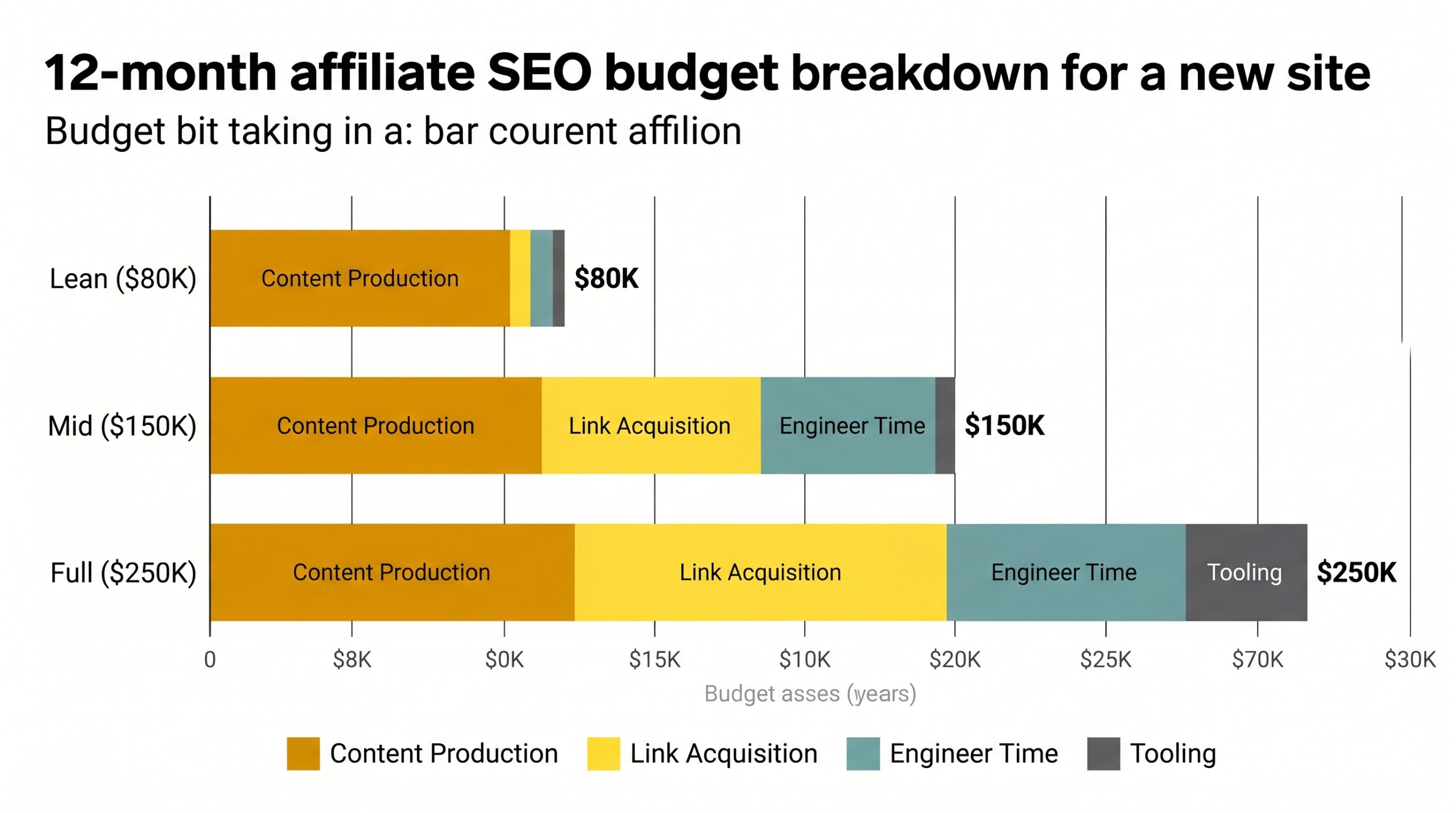
The honest cost breakdown for a new affiliate site in 2026 — meaning a domain you start from zero and intend to monetise meaningfully within 18 months — is uncomfortable to hear and routinely underestimated by people quoting 2019 numbers.
Content production
A 2,500-word article with original research, original imagery, and a named author who actually wrote it costs $400–$1,200 to produce in-house, depending on whether the author is full-time staff or freelance. AI-assisted production is cheaper per word but, as covered above, the all-AI cohort got categorically penalised. The viable model is “human writer with AI research assistance,” which doesn’t dramatically change the per-article cost.
A 30-article launch corpus is $12,000–$36,000. A monthly cadence of 8 articles for a year is $40,000–$115,000. These are publisher-sized numbers, not blogger-sized.
Link acquisition
This is where 2026 economics diverged most sharply from prior years. Per Ahrefs’ 2026 industry survey, the average niche-edit backlink costs $361.44, guest posts average $77–$220, and a placement on a DR-50+ domain runs around $600. The same survey reports 76% of SEOs willing to pay $300+ per link and 47% willing to pay $500+. Premium editorial placements regularly cross $1,500–$5,000.
The implication for budget planning: a meaningful link profile for a competitive affiliate niche is rarely under $20,000 in the first 12 months, and the “do nothing on links and rely on natural earned” strategy that worked in 2018 doesn’t work in 2026 — there’s too much competing inventory and editorial sites have hardened against unpaid outreach.
Engineer time
This is the hidden cost most affiliate-SEO planning skips. A modern site needs: schema markup that actually validates, Core Web Vitals consistently in the green at the page-template level (not just on the homepage), a CDN setup that handles your geo distribution, structured-data testing on every deploy, and a programmatic-pipeline maintenance budget if you’re doing programmatic SEO. Realistic engineer time in our publishers’ setups: 0.2–0.5 FTE for a 100–500 page site, 1.0+ FTE for anything programmatic.
The real all-in number
A serious 2026 affiliate-SEO site, year one, all-in: $80,000–$250,000 depending on niche competitiveness, link budget, and content scale. Year two is meaningfully cheaper because authority compounds and link costs front-load. The sites making money on $20K/year budgets exist but are almost all sites that started in 2018–2020 on early-mover authority.
If you’re being sold on “$5K and you’ll be ranking in 90 days” by an SEO vendor in 2026, you’re being sold the 2018 playbook in a 2026 market. The math no longer works.
Which edge cases will bite you that competitors don’t write about?
The standard “ultimate guide” articles that compete for the seo for affiliate marketing query mostly stop at “write helpful content and build links.” The actually-load-bearing edge cases below are what determine whether your funnel survives 2026.
AI Overviews ate the top of the funnel
When Google’s AI Overviews answer a query in the SERP, the click-through rate to underlying organic results drops sharply. The exact magnitude varies by query — informational queries see the largest drops, commercial-intent queries the smallest — but the pattern is consistent.
For affiliate sites, this means the head-of-funnel “what is X” content that used to feed your retargeting and email-capture funnel is being intercepted. You can still get cited inside the AI Overview (which is its own optimisation problem), but the click traffic is shrinking. Recovery strategy: shift content investment toward mid-funnel commercial-intent queries where the user still wants comparison detail, screenshots, and a buying decision — those continue to drive clicks.
Parasite SEO is back, with risks
Publishing affiliate-monetised content on high-DR third-party platforms (Medium, LinkedIn, Substack, niche industry publications) recovered as a tactic in 2025 because it borrows authority from a domain Google already trusts. Several of our publishers have built meaningful affiliate revenue this way without owning a primary content site at all.
The risk: Google has been issuing manual actions against host platforms for affiliate-link abuse, and several previously reliable hosts (notably some Medium publications and a handful of news sites that were running “sponsored editorial”) have lost all rankings overnight. If you build your funnel on a parasite, build with the assumption that the host could be deindexed in any given month. Diversification is mandatory.
The dating-vertical wrinkle
Dating-affiliate SEO has a few quirks general-SEO advice doesn’t cover. Google’s quality raters apply heightened scrutiny to adult-adjacent verticals; the EEAT bar is higher; and a chunk of the highest-converting commercial-intent queries (best dating apps for [specific demographic]) sit in YMYL territory because they touch user safety and relationship advice. Our higher-traffic dating-content publishers all have the same shape: identifiable expert authors (often with relationship-coaching or dating-industry credentials), citation density to academic and journalistic sources, and an explicit safety section per page. The publishers who try to rank dating offers from generic affiliate-site templates underperform their nutra and gambling counterparts at similar domain authority.
iOS Safari and the conversion-window mismatch
This is more of a tracking issue than an SEO issue, but it bites the same publishers. Affiliate SEO traffic from iOS Safari arrives with all of Apple’s ITP cookie restrictions, meaning the 7-day attribution window your network reports against is actually capturing 24-hour Safari conversions accurately and dropping a meaningful slice of the rest. If your SEO traffic is heavy iOS (Tier-1 dating, tech reviews, premium e-commerce), the gap between actual conversions and reported conversions can run 15–30%. Don’t let an attribution gap convince you your SEO traffic doesn’t convert.
How should I structure a new affiliate site I’m starting in 2026?
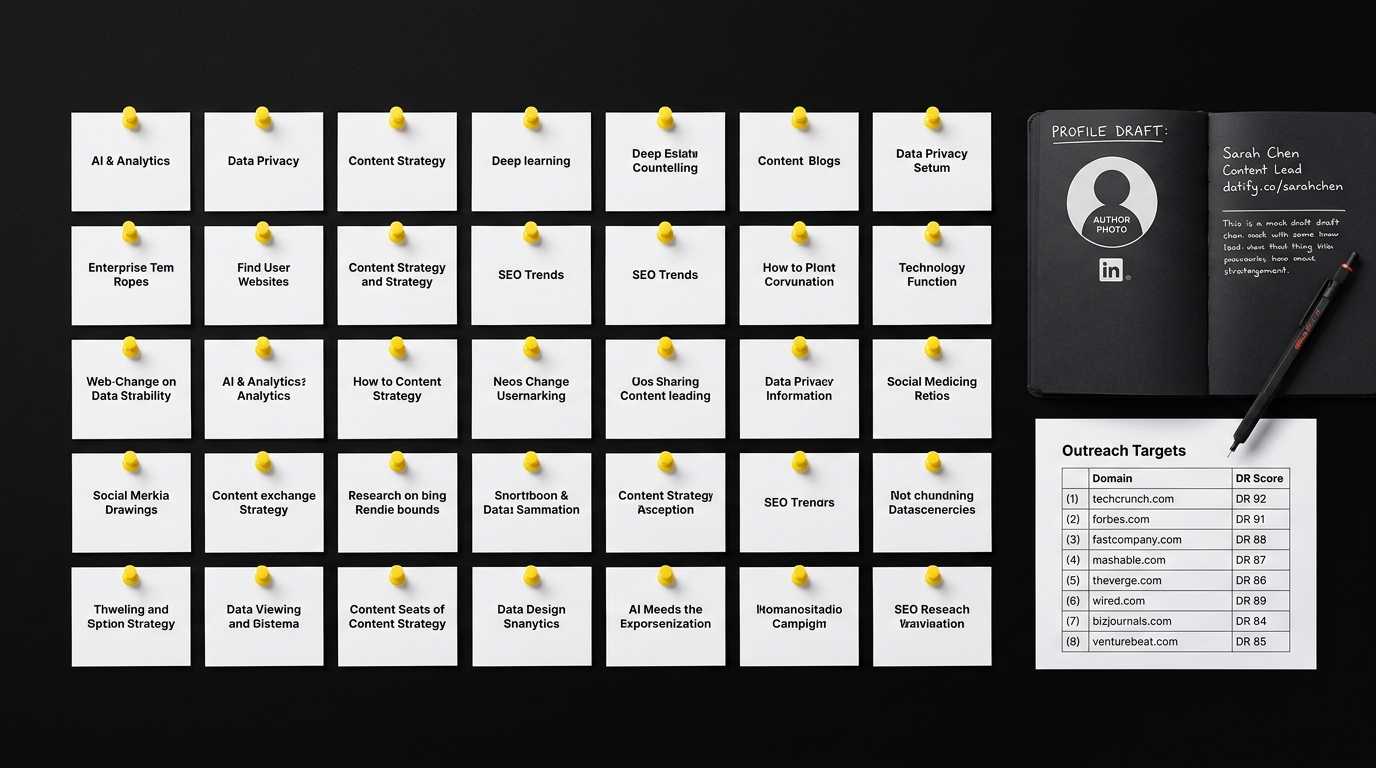
If you’re starting a new affiliate-SEO site this quarter — knowing everything above — the structure with the best survival odds in our publishers’ experience:
Topical scope: Narrow. One vertical, one audience, one country initially. “Best dating apps for professionals over 40 in the US” is a viable niche; “best dating apps” is not.
Author setup: One named author for the first 12–18 months, with verifiable expertise. If that’s you, build a real author page with a LinkedIn link and a publication archive.
Initial content: 25–40 pages of dense, original-experience content. Not 250.
Link strategy: Budget $8,000–$15,000 in the first six months for editorial outreach. Accept that a chunk of placements will be guest posts and HARO-style citations rather than direct sales pages — pure paid-link strategies attract manual actions.
Monetisation: Affiliate links in-context, never sidebar banners or footer link blocks. Disclosure should be specific and above-the-fold on commercial pages.
Time horizon: 12 months minimum to meaningful organic traffic; 18 months to break even; 24+ months to compound. If your investment thesis assumes faster, the thesis is wrong.
For Datify-network publishers specifically, we recommend pairing a content-SEO funnel with at least one paid-traffic source rather than running pure-SEO. The cash-flow timing of SEO (long delay before revenue) and paid (immediate) are complementary, and the brand signals from paid traffic feed back into SEO authority over 12–24 months — we cover the paid side in our traffic-source breakdowns.
FAQ
Q: Is SEO still worth doing for affiliate marketing in 2026?
Yes, but the bar is higher than at any point since 2012. Sites with named authors, demonstrable first-hand experience, narrow topical focus, and serious link budgets continue to make money — in some cases more than ever, because the supply of competing content has shrunk after the 2025–2026 update sequence purged thin-affiliate inventory. The fast, cheap, scaled approach is dead; the slow, expensive, deep approach works.
Q: How long does it take to recover from a Google core update penalty on an affiliate site?
In our publisher network’s experience, 4–9 months from the bottom of the loss to a meaningful rebound, and only contingent on a subsequent core update rolling out — Google re-evaluates in update waves, not continuously. The publishers who try half-measures (light content edits, no structural change) typically don’t recover at all and end up rebuilding on a new domain after 9–12 months.
Q: What’s the difference between programmatic SEO that works and programmatic SEO that gets penalised in 2026?
Unique data. A programmatic page that templates a public dataset (Wikipedia city populations, scraped product specs) is the exact pattern Google’s classifiers got very good at flagging as thin in 2025. A programmatic page that surfaces a unique, refreshed-frequently data point — your tracker’s current conversion rate per GEO, your network’s live offer payouts, your inventory’s real-time pricing — adds value no competitor can replicate and survives the classifier.
Q: How much should I spend on link building for a new affiliate site?
Per Ahrefs’ 2026 link-building survey, the average niche-edit backlink costs $361.44 and DR-50+ placements average around $600. A serious link budget for a new competitive affiliate niche starts at $8,000–$15,000 in the first six months and $20,000–$40,000 in the first 12 months. Mix paid editorial placements (60%), HARO-style earned citations (25%), and unpaid outreach guest posts (15%).
Q: Are AI Overviews killing affiliate SEO traffic?
They’re killing the head-of-funnel slice (informational queries that resolve in the SERP) but leaving the mid-to-bottom-funnel intact, where users still want comparison detail and screenshots before clicking. Shift content investment toward commercial-intent comparison content — which is also where EEAT signals matter most. Don’t defend “what is X” content; redirect that production budget into “X vs Y for Z use case” content.
Q: Do I need to disclose affiliate relationships, and does disclosure hurt rankings?
Yes — required for FTC compliance in the US and similar frameworks in the EU, UK, Canada, and Australia. Disclosure does not hurt rankings; concealment can attract spam-policy violations under Google’s thin-affiliate guidance. Disclosure should be specific and visible above the fold on commercial-intent pages — not “we may earn a commission” buried in the footer.
Q: Is parasite SEO (publishing on Medium, LinkedIn, third-party domains) a viable affiliate-SEO strategy in 2026?
A viable supplementary strategy, not a primary one. Borrowing the authority of a high-DR host accelerates ranking on commercial queries, and several of our publishers have built meaningful revenue this way. The risk: Google has been issuing manual actions against host platforms for affiliate-link abuse, so any parasite host can lose all rankings in a single update. Treat it as one diversification leg.
Q: What single change would most improve a struggling affiliate site’s SEO in 2026?
Replace the byline. Go from “Editorial Team” or a fictitious author to a real, named, verifiable expert with a working LinkedIn profile and a publication history that supports the topical authority claim. Several of our publishers who made only this change — same content, same site, just an honest author overhaul — saw measurable ranking improvement within two core-update cycles.
Bibliography
- Google Search Central — Spam Policies for Google Web Search (thin-affiliate guidance). Tier-1 primary.
- Ahrefs — 2026 industry link-building cost survey, compiled by editorial.link. Industry primary.
- ALM Corp — Google December 2025 Core Update analysis and March 2026 update implications. SEO industry analysis.
- WebmasterWorld — Google Search & SEO forum threads, December 2025 and 2026 update observation threads. Operator forum.
- Hobo Web — The Google Helpful Content Update and its relevance in 2026. SEO industry analysis.
- Automattic Affiliates — Affiliate content SEO in 2026: why rankings dropped and how to recover. Platform-vendor primary.