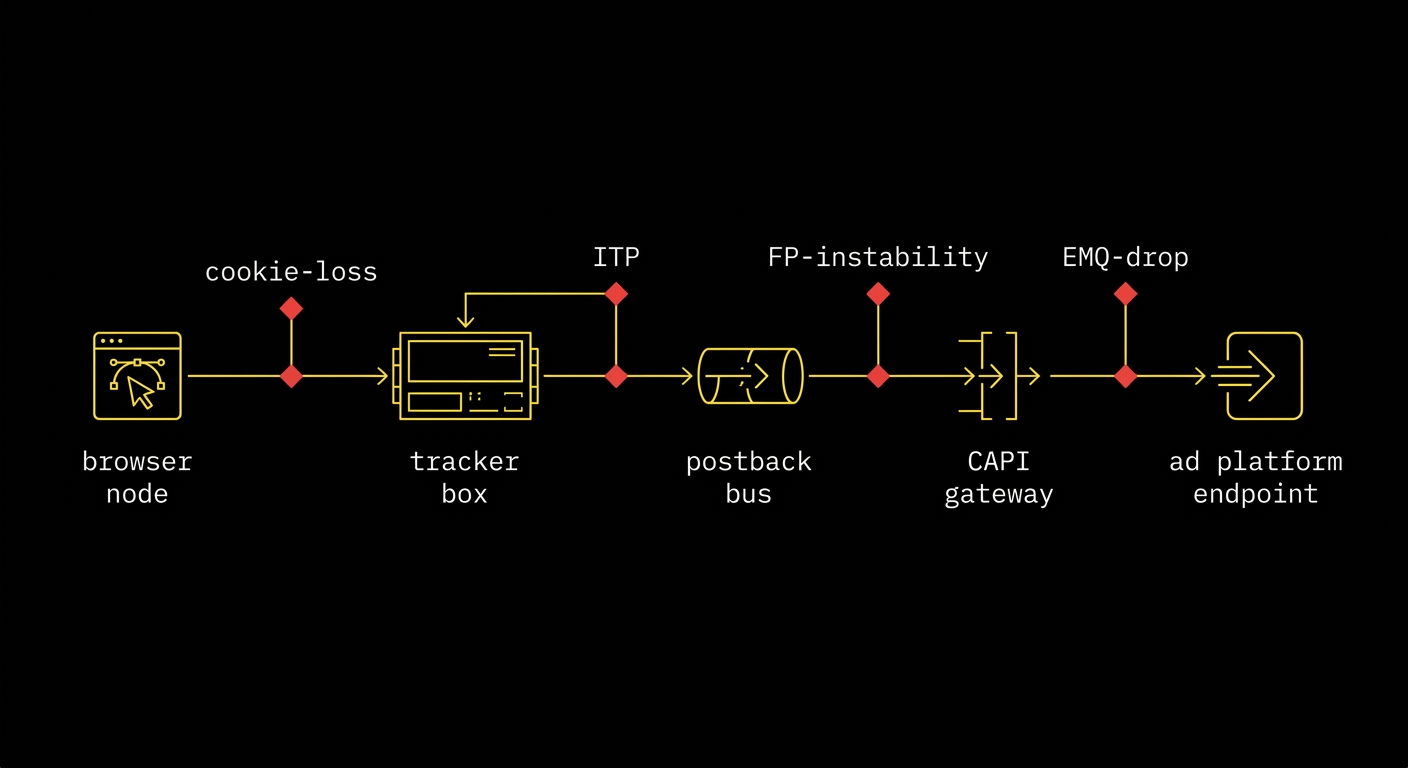
The most useful frame for affiliate marketing trends 2026 isn’t “AI changed everything” — it’s “the tracking layer under your campaigns just got rebuilt.” Privacy Sandbox formally died in October 2025. Meta shipped one-click CAPI in April 2026 and quietly moved the operational floor with it. Apple’s AdAttributionKit now ships the features SKAdNetwork never had. Fraud farms got AI-coached. If your tracker, postback, or CAPI integration is from 2023, it’s already a liability — and most of what’s being sold as “2026 attribution” is 2023’s stack repackaged.
Editorial disclosure: Datify operates an Affise-stack affiliate network for dating offers. I run our tracker integration matrix and our CAPI bridge across Voluum, RedTrack, Binom, and ClickFlare. The trends below are filtered through what my team actually sees in production postback logs, not what we’d say on a vendor webinar.
Key Takeaways
- Privacy Sandbox is over. Google formally retired Topics, Protected Audience, Attribution Reporting and most of the rest on Oct 17, 2025. Third-party cookies stay in Chrome. The “cookieless attribution” sales pitch is dead in the form it had through 2024.
- CAPI moved from “recommended” to operational floor. Meta shipped one-click CAPI in Events Manager on Apr 15, 2026; TikTok Events API, Google Enhanced Conversions and Reddit CAPI are no longer optional for any dating buyer with mobile-Safari traffic.
- AdAttributionKit is the new iOS attribution surface. AAK 18.4 added overlapping re-engagement, configurable per-network attribution windows, install/re-engagement cooldowns, and country codes in postbacks — features SKAdNetwork was never going to get. Skip migration and you eat truncated postbacks on Tier-2 dating offers.
- Fraud farms are AI-coached now. Human farms now pair with LLM typing simulators and residential-proxy meshes. Browser-level anti-fingerprinting is eroding device-hash signals industry-wide, pushing fraud detection toward layered, network-side methods.
- The “hyped but not real” pile is bigger than the real-shift pile. Fully-AI landers, on-chain attribution, “Privacy-Sandbox-native” trackers, and the supposed Meta→TikTok pivot for premium dating all collapse on close inspection.
What actually changed in 2026 vs. the trends decks everyone repeated?
Most of the “2026 trends” decks I read in late 2025 were wrong in the same way: they front-loaded Privacy Sandbox migration, AI creative, and Web3 attribution, and back-loaded the boring stuff that actually mattered. The boring stuff was a tracker-and-CAPI rebuild driven by Apple, Meta, and the slow death of pixel-only measurement on mobile Safari.
The single biggest non-event was Privacy Sandbox shutting down. Every roadmap I’d seen — vendor decks, attribution-platform whitepapers, even a couple of internal Datify planning docs — was budgeting engineering time against migration to Topics, Protected Audience, and Attribution Reporting. On Oct 17, 2025, Google published Update on Plans for Privacy Sandbox Technologies and retired most of those APIs in one stroke. Third-party cookies stay in Chrome. CHIPS, FedCM and Private State Tokens survive; everything else got pulled. The CMA released Google from its commitments the same day — and per AdExchanger’s coverage, all 15 respondents to the CMA consultation opposed the release. The regulator did it anyway.
The flip side of that non-event was a real one: Safari and iOS kept tightening exactly the surface Chrome had decided not to. So the 2026 attribution problem isn’t “all browsers are turning off cookies” — it’s “Chrome still works the way you remember and Safari/iOS are where your stack falls apart.” That is not the trend slide that won SaaS conference attention, but it’s the one that matters when you’re sitting at our reconciliation dashboard at the end of the month.
A note on Datify-side observables, because the rest of this article references them. Our S2S postbacks expose a row of sub_id parameters. sub_id_7 carries the user’s real IP via Keitaro’s {ip} macro, which we feed into Meta CAPI’s client_ip_address field, and sub_id_12 carries an optional upstream quality signal. That postback layout has stayed stable through Privacy Sandbox shutdown, Meta’s CAPI changes, and iOS 26 — the surface lives below the browser layer, so when the browser layer thrashes, our affiliate integrations don’t.
Why did Meta CAPI go from “recommended” to non-negotiable for dating?
For three years the polite advice on Meta CAPI was “wire it up alongside the pixel for dedup, you’ll see a small EMQ lift.” For dating in 2026 that’s no longer accurate. Pixel-only loses upward of 50% of mobile-Safari conversions and more than 35% of web traffic to ad-blockers and consent banners; the only question for a dating buyer at any meaningful scale is which CAPI implementation hurts least to operate.
The April 15, 2026 shipment of Meta’s one-click CAPI inside Events Manager (covered by AdExchanger) collapsed the cost of entry. Before that, a respectable CAPI implementation meant either a paid Stape/Tagmate gateway, a self-hosted Google Tag Manager Server-Side container, or a tracker like RedTrack or ClickFlare wiring CAPI events through its own server. One-click CAPI doesn’t replace those — but it eats the bottom of the market and resets what “no excuse not to have CAPI” looks like.
Here’s the part the vendor blog posts don’t tell you, and the part that has cost my team time. CAPI does not replace the pixel — it deduplicates with it. The pixel still has to fire. Both sides must agree on event_id, both sides must report the same hashed PII, both sides must see the same fbc/fbp cookies, and the IP family (IPv4 vs IPv6) has to match across the pixel-side and server-side event. When any of that drifts, Meta’s Event Match Quality score silently collapses below 5/10 and the algorithm quietly de-optimises your campaign. There is no banner, no email, no API warning. You find out by noticing your CPM drift two weeks after the issue started.
The breakpoints we see most often in our reconciliation logs, in rough frequency order:
event_idcollision or drift. The tracker generates one event_id for the pixel fire, Keitaro generates a different one for the S2S postback, the affiliate’s hand-rolled GTM tag generates a third. Meta sees three events, dedups none of them, and the EMQ math gets contaminated.- Stale or wrong IP on the server-side event. This is the single most common reason we route the real IP through
sub_id_7— without it, the CAPI event arrives with the Keitaro server’s IP, not the user’s, and Meta’s match logic falls back to weaker signals. - Hashed-email format errors. SHA-256 lowercased trimmed is the only acceptable format. Half the GTM templates I’ve audited normalise inconsistently — one strips whitespace, another lowercases first then strips, a third forgets the
+alias handling. Every variation costs match rate. - Missing
fbc/fbp. Especially on iOS where Safari intermittently drops them. CAPI events arriving without these have systematically lower EMQ.
There’s a forum-debugging thread on affLIFT — Facebook tracks fewer leads than the MaxConv tracker — where a buyer chases a 20% gap between tracker-confirmed leads and Meta-attributed leads for weeks, and the answer in the back-and-forth is always one of the four bullets above. None of them are exotic. All of them silently kill EMQ. On the tracker side, I cover the operator-debug story for our five mainline trackers in Best Affiliate Trackers 2026 — RedTrack’s #-fragment CAPI silence is the one that ate a week of my March in particular.
Privacy Sandbox is dead — what’s the actual 2026 attribution stack?
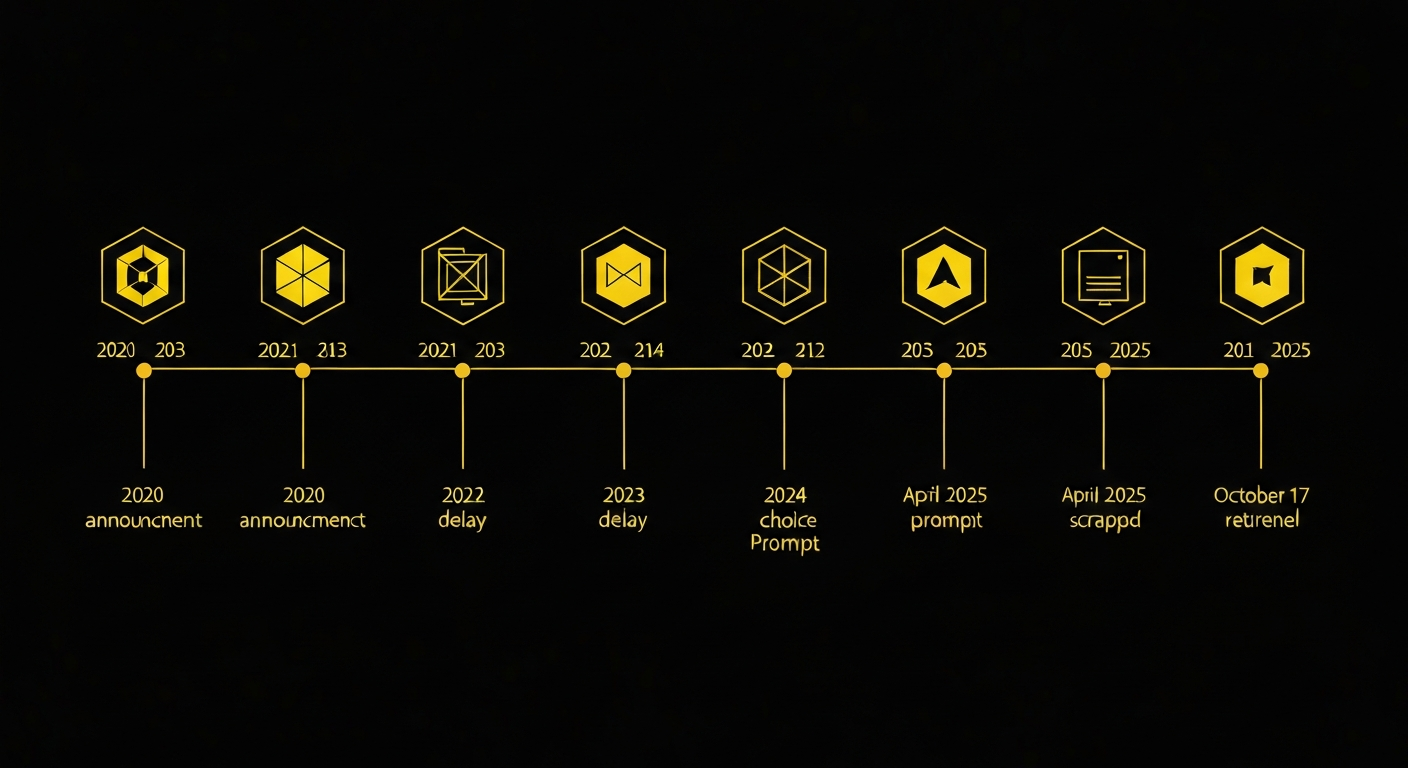
If you ran any kind of identity-graph or fingerprint-fallback project in 2023–2024 sold as a “Privacy Sandbox bridge,” you should be quietly retiring that line item. Privacy Sandbox APIs that were going to be the bridge are gone. The retirements list from the Oct 17 announcement, verbatim from Google’s blog post: Attribution Reporting API (Chrome and Android), IP Protection, On-Device Personalization, Private Aggregation including Shared Storage, Protected Audience (Chrome and Android), Protected App Signals, Related Website Sets, SelectURL, SDK Runtime, and Topics (Chrome and Android). What survives: CHIPS, FedCM, Private State Tokens. None of those three is an affiliate-grade attribution surface today.
The actual 2026 attribution stack is unglamorous and looks a lot like 2022’s stack with two upgrades:
First-party cookies + server-side identity stitching on Chrome. Standard tracker click-ID + cookie + CAPI dedup. The thing Privacy Sandbox was supposed to replace.
Fingerprint-as-supplement, not fingerprint-as-primary on Safari. Safari 26 ships Advanced Fingerprinting Protection by default, with canvas/WebGL noise injection, AudioBuffer perturbation and font-enum suppression. That makes device-hash signals unstable for the same real user on Safari, so any fraud logic that leans on fingerprint reuse as a primary signal risks false positives on Safari traffic — fingerprint should be one input among several, not the deciding one.
CAPI on the way out and AAK on the way in for mobile. Covered in the next section.
The hidden cost most “cookieless attribution” vendor pitches paper over: the actual cookieless infrastructure is Private State Tokens and FedCM, both of which are real W3C tech and neither of which is wired into Meta, Google Ads, TikTok, or any of the affiliate trackers I run. Until that wiring exists, “cookieless attribution” means fingerprinting plus first-party cookies plus a CAPI bridge — which is the same stack we were running in 2023. Calling that “cookieless” is a vocabulary choice, not a technology shift.
A quick honest negative on the tracker-vendor side: every multi-platform tracker I work with shipped Privacy Sandbox roadmap items at some point in 2023–2024. None of them refunded the engineering time when those features turned out to be dead code. If you signed a multi-year commitment partly on the strength of those roadmap items, that’s a conversation worth having with your account manager.
How does AdAttributionKit replace SKAdNetwork — and what breaks if you skip migration?
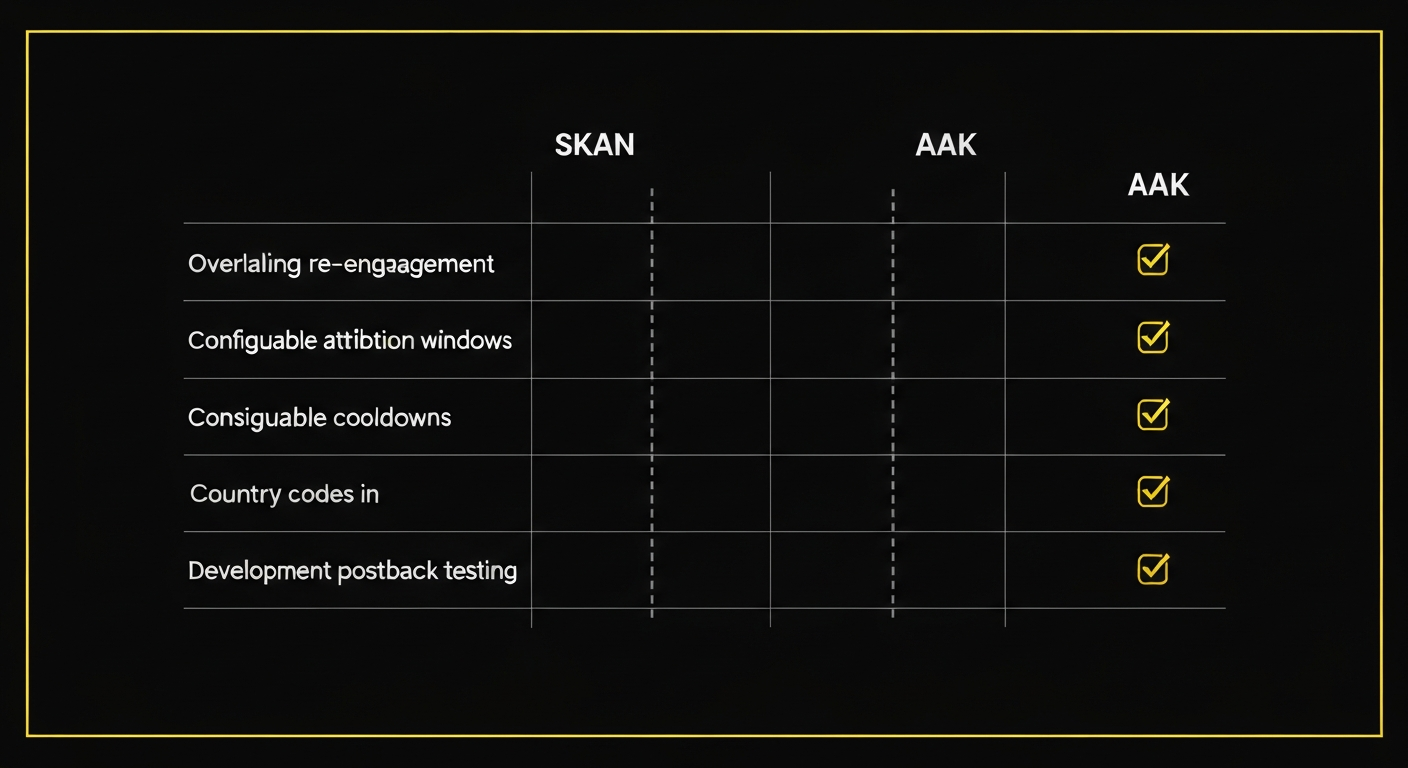
Apple has not formally deprecated SKAdNetwork, but in practice WWDC25 session 221 on AdAttributionKit is the signal: every new mobile-attribution capability is shipping in AAK, not SKAN. iOS 18.4 added four meaningful things, all confirmed in the WWDC25 session and the AAK/SKAN interoperability docs:
- Overlapping re-engagement conversions with conversion tags. Previously a single re-engagement window per app; now multiple parallel windows, each marked with a
conversionTagstring. For dating, this is the difference between being able to attribute a winback campaign and a premium-upgrade campaign at the same time vs. having to pick one. - Configurable per-network attribution windows. Used to be a fixed 30-day click / 1-day view. Now defined per ad network in Info.plist under
AdAttributionKitConfigurations.AttributionWindows— for example, 2-day click / 1-day view for a network where you want short attribution and don’t want to over-credit late conversions. - Configurable cooldowns via
install-cooldown-hoursandreengagement-cooldown-hours. Prevents overlapping conversions from misattributing the same user twice. - Country code in postbacks — derived from App Store storefront for installs (subject to crowd-anonymity thresholds). This is genuinely useful for GEO-level CV mapping and was a long-standing SKAN gap.
Plus a development-side win: postbacks can be configured directly in Settings > Developer Settings > Ad Attribution Testing, with a tagged development.adattributionkit payload. That sounds boring until the first time you debug a broken CV mapping in production and realise SKAN never had this.
What breaks if you skip migration:
- Crowd-anonymity postback suppression on Tier-2 dating. AAK keeps SKAN’s privacy threshold — if a CV × country bucket doesn’t hit the anonymity floor, the postback gets truncated or suppressed entirely. On low-volume Tier-2 GEOs, this systematically eats data. The fix is the same as it was on SKAN: aggregate rare conversions into broader CV buckets so each cell crosses the threshold. The bug in not migrating is that AAK’s broader country-code field gives you more visibility into where this is happening, which SKAN never did.
- JWS signing key handling between prod and dev. AAK postbacks use new JWS keys with different
kidvalues in development vs. production payloads. Trackers and CAPI bridges have to handle both. A tracker that only validates the productionkidwill silently drop every dev postback during integration testing — and you won’t notice until you ship. - Re-engagement attribution. AAK 18.4 supports overlapping re-engagement; SKAN doesn’t. For a dating app running parallel winback and upsell, that’s the entire campaign-attribution model.
The version edge case nobody talks about: AAK 18.4 features are obviously unavailable on iOS 17.x and earlier. On a global audience with a long iOS-version tail, you run both pipelines (AAK on 18.4+, SKAN as fallback) for at least the next 12 months. That doubles tracker integration cost on the mobile side. The vendor pricing pages do not call this out.
What’s the new fraud-farm playbook — and how do trackers catch AI-coached human farms?
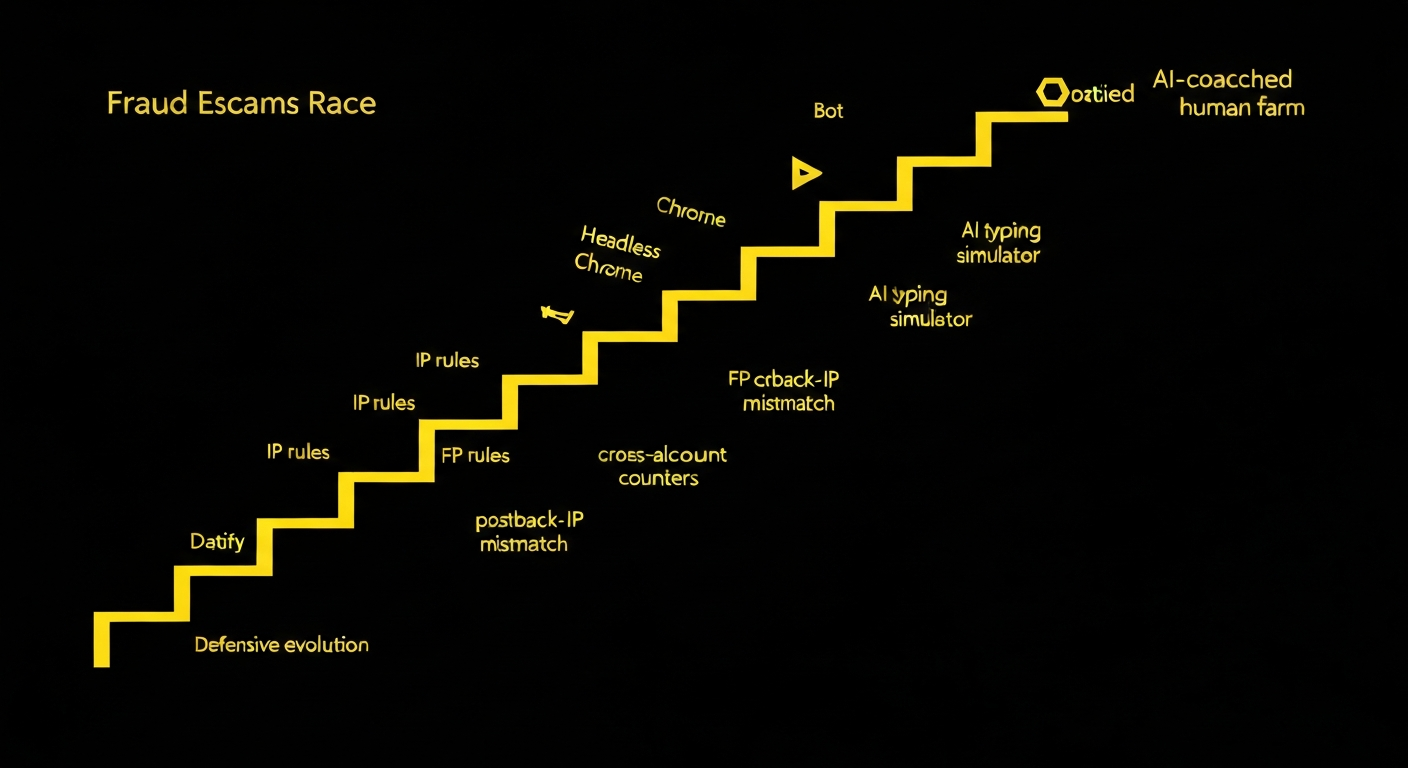
The most genuinely new thing on the fraud side in 2026 is the AI/human hybrid. The fraud-farm baseline has shifted through 2024 and 2025 from brute-force click farms to operations that pair human operators — paid at low local-labour rates per industry reporting in Leadgen Economy’s fraud-detection write-up — with LLM-driven typing simulators, residential-proxy meshes, and anti-detect browser sessions. Every per-account heuristic the industry built in 2020–2023 — IP geography, recycled FP, UA mismatch — has been solved on the fraud side at the cost of a residential proxy subscription. The economics still favour the fraud operator, which is why human farms remain cheap enough to be the dominant threat above bot farms.
The honest read on where detection still works: network-level cross-account aggregation. Per-publisher trackers can’t see this because a fraud farm rotates its accounts across publishers; only the network sees the full graph. The kinds of signals the industry leans on at that layer:
- Device-fingerprint reuse across accounts. A network can watch for the same device fingerprint reappearing across many affiliate accounts – a pattern a single publisher’s tracker can’t see. Fingerprint reliability varies by browser, which is one reason mature networks treat it as one input among several rather than a sole decider.
- Cross-signal origin checks. Comparing where a click originates against where its conversion postback fires is a standard network-side technique – a click from a residential proxy in one region paired with a postback from a server in another is a loud signal that per-account checks miss.
- Submission timing. Real users on a dating SOI lander take a human amount of time before the email field receives focus, while scripted submissions tend to fire much faster. On its own it’s a weak signal, but at the network layer it’s one more input the per-publisher view doesn’t have.
Our ops team’s observation, not a formal export: across the four trackers we bridge, when a CAPI event-quality regression appears, it tends to surface in our reconciliation logs 24–72 hours before it shows up in vendor dashboards — because we’re computing it directly off raw S2S postback streams rather than waiting for the platform’s daily aggregation. That lead time is the single most operationally valuable thing about running CAPI through our own bridge instead of letting the tracker handle it end-to-end.
A direct honest negative on the ML-fraud vendor side: pure-ML “AI fraud detection” pitches that I’ve evaluated for Datify in 2025–2026 consistently underperform heuristic rules on the production decision metric — false positives per fraud catch — once you account for the false-positive cost on real publishers. ML is useful as an augment to heuristics; it is not the replacement most vendors price it as, and it is not what you put in front of a payout decision.
CPA, RevShare or hybrid — which payout model wins for affiliates in 2026?
The 2026 payout-model shift in dating is hybrid CPA + RevShare moving from “premium-offer special case” to default rate-card on a meaningful share of new offers. Economics are roughly 50% of pure-CPA upfront plus a 25–40% RevShare on user lifetime — covered well in IREV’s hybrid-commission write-up. The network shares fraud risk (lower upfront); the affiliate shares quality risk (RevShare requires user retention).
The reason this works in 2026 specifically, and didn’t five years ago: networks now have faster, layered network-side fraud-scrubbing, which lowers the risk premium on the upfront CPA portion. Without that, hybrid was a sweetheart deal for the network and a long-tail bet for the affiliate. With it, both sides can model their downside.
The thing that bites at scale on hybrid: RevShare ledger opacity. Most networks publish summary RevShare numbers but not per-user lifetime curves. Once an affiliate is doing more than around $30K/month in expected RevShare, the difference between the network’s claimed “average LTV” and the realised number is large enough to matter — and the affiliate has no audit path. The fix isn’t to trust the network’s average; it’s to model expected RevShare against the network’s claimed average, treat the gap as a BS index, and reprice your upfront accordingly. Pure-CPA still wins for affiliates whose primary skill is media buying without the patience to model long-tail retention.
For the dating-traffic side of the same trend — which platforms are paying out best on which payout model in 2026 — I cover that in Dating Traffic Sources Complete Guide 2026, specifically the section comparing FB-PPS, push, and native economics under realised-eCPM (not ratecard) math.
Where is the realised-eCPM gap as CAPI tightens?
Two related shifts you don’t usually see flagged in the trends decks. First, as CAPI matures and EMQ scoring becomes more central to platform auto-optimisation, the realised eCPM gap between sloppy-CAPI and clean-CAPI affiliates is widening. A clean CAPI setup gets better Meta auto-bidding, which gets better placements, which gets better CR. That’s a compound effect — affiliates who treated CAPI as a tickbox in 2023 are eating a 10–25% disadvantage to affiliates who treated it as a measurement-recovery system. Second, scrub windows are getting longer on premium offers and shorter on cheap offers. Networks that are routing CPA + RevShare hybrids extend scrub to 30–45 days to validate retention; networks selling pure-CPA on low-AOV smartlinks pull scrub windows in to under 14 days. From an affiliate-cashflow perspective, that’s a planning shift, not a P&L shift.
Smartlink consolidation continues — AffiliateFix threads like Best Adult Dating Smartlink Network consistently surface the same 6–8 networks (CrakRevenue, AdsEmpire, LosPollos, Mobidea, ProfitSocial, MyLead, Adsterra, Trafee) because smartlinks are now the default beginner product across mainstream and adult dating. The trend isn’t more smartlinks; it’s smartlinks becoming the floor, with non-smartlink direct-offer relationships moving to either premium PPS/RevShare deals or true media-buy partnerships above ~$50K/mo affiliate revenue.
Why is Tier-2 saturating and where is the real GEO opportunity for 2026?
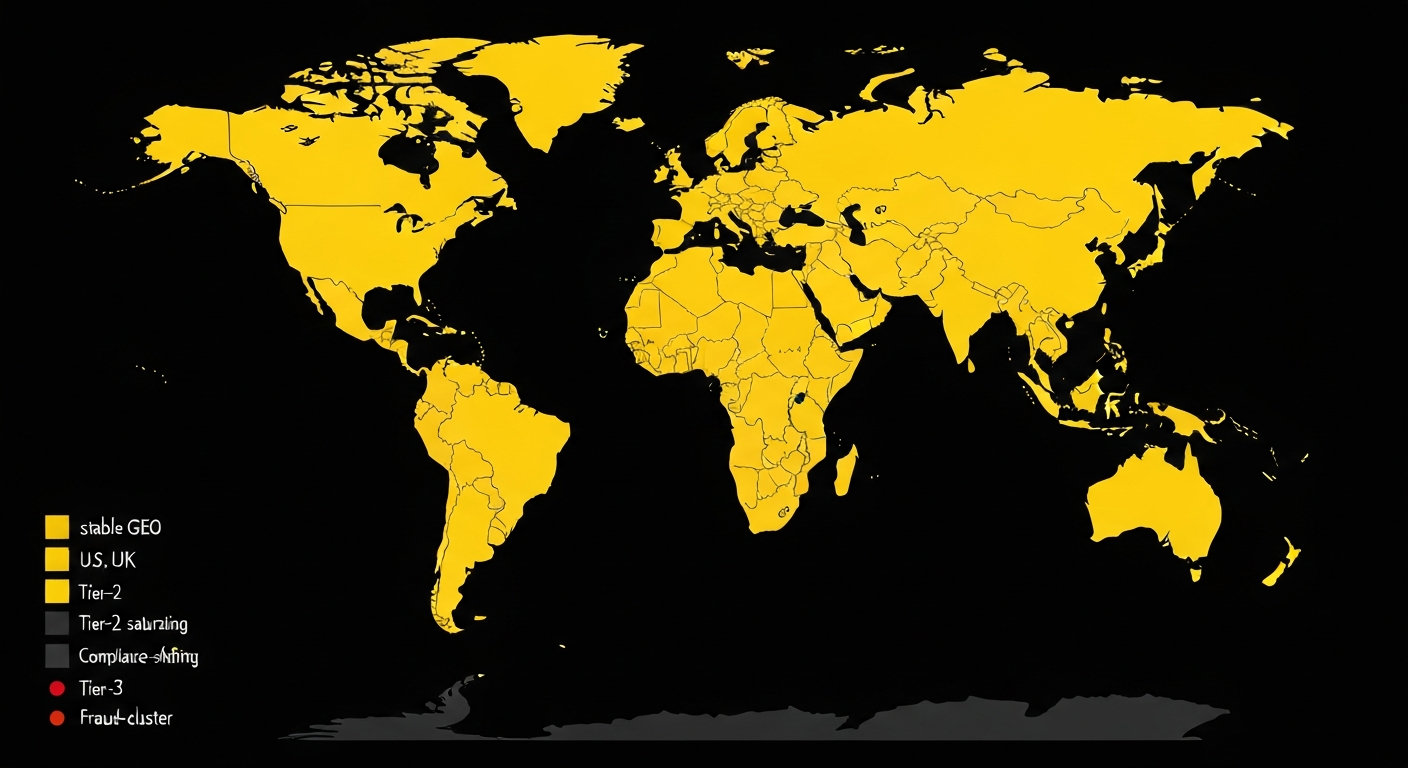
Brazil, Mexico, Argentina, and Turkey are the canonical “Tier-2 dating GEOs” that beginners migrate into when they get banned out of US Facebook. The 2026 reality is that all four are saturating: Meta CPMs are up 30–60% YoY across them, EPC is compressing as more affiliates compete, and the realised eCPM has narrowed substantially against US offers.
On Brazil specifically, Pix is now de facto required for dating monetisation. A credit-card-only checkout on a BR-localised flow collapses CR by roughly 40–60% versus a Pix-enabled flow — Copperx’s Pix primer gives the high-level mechanics if you haven’t worked with it. The infrastructure trend, not the marketing trend, is that 2026 dating affiliates running BR need a payment-rail-aware lander; the offer that does best is the one whose checkout doesn’t ask the user to pull out a card.
On India, UPI is the rail — over 21 billion transactions a month in late 2025 and over 500 million active users, per NPCI’s published statistics. Dating affiliates routing IN have to work through UPI-facilitator PSPs because mainstream UPI processors (Razorpay, Cashfree) reject high-risk dating verticals. The DPDP compliance deadline — Phase III hard enforcement on May 13, 2027, with Phase II consent managers on Nov 13, 2026, per India Briefing’s DPDP timeline — gives the network and the affiliate a roughly 18-month runway to get consent management wired in. Don’t start that integration in May 2027.
A note on Tier-3 fraud clusters: BD, PK, ID, PH, VN, and EG continue to be documented sources of affiliate fraud-farm activity, including the AI-coached human farms covered in the fraud section above. These should be treated as fraud-source GEOs first and traffic GEOs second — the realised quality after fraud netting rarely makes the gross-revenue math work for a mainstream dating offer.
How are DSA, DPDP and CCPA 2026 reshaping affiliate compliance?
The compliance shifts are not bullet items you can ignore from the tracker seat — every one of them maps to a postback field, a consent flag, or a data-handling change in our pipeline.
EU DSA on dating. Platforms must declare an EU legal Point of Contact, run transparent moderation, and respond to law-enforcement, trusted-flagger and out-of-court dispute requests within statutory windows. Fines run up to 6% of global annual turnover. The European Commission’s two-years-of-DSA review in February 2026 flagged age verification as the 2026 focus area — and the EU’s age-verification app rolled out through 2026 changes the compliance posture for dating offers serving EU users. From a tracker engineer’s seat, the practical change is consent flags now need to round-trip through the postback chain accurately; sloppy gdpr=1 handling that worked in 2022 fails a DSA audit.
India DPDP. Soft enforcement through 2026, hard from May 13, 2027 per the MeitY notification and the Shardul Amarchand summary on Lexology. The practical work for affiliates routing IN traffic is consent-manager wiring and data-localisation handling — neither of which the tracker industry has shipped clean defaults for yet.
CCPA/CPRA Jan 1, 2026 amendments. The amendment that bites affiliate setups specifically: a Risk Assessment is now required before sell or share of personal information, and “sharing” explicitly includes tracking-ID transfer for ad attribution. Many affiliate funnels that thought of themselves as not selling data now trigger “share” status under the amended definition. Browser GPC signals must be honoured. Intentional violation: $7,988 per incident. Nineteen US states now have full-scope privacy laws on the books per Jackson Lewis’s coverage of the 2026 amendments.
FTC affiliate-disclosure enforcement. January 2026 saw the first warning letters under the Consumer Review Rule — ten companies cited for fake reviews and undisclosed incentivised testimonials. “Clear and conspicuous” disclosure is required across Reels, TikTok and livestreams; AI endorsements carry the same disclosure obligation as human endorsements. The FTC’s endorsements guidance is the canonical source. Documented penalties have exceeded $600K per violation.
The point a tracker engineer cares about: every one of those four regulatory shifts has a knock-on in our postback layer (consent flags, region-aware data handling, suppression on GPC, retention-period enforcement). They’re not “marketing compliance” — they’re integration work.
How is network-side KYC tightening — and what does it mean for new publishers?
Affiliate-network KYC is shifting from one-time document upload at signup to continuous monitoring through the publisher lifecycle, tracked against payout patterns, IP history, traffic mix, and ownership-graph signals. Industry write-ups like Sumsub’s KYC in 2026 and The Paypers’ fraud + KYC analysis describe this in the broader fintech context — the affiliate-network application is essentially the same threat model. Shell companies, layered ownership, short-lived domains, AI-fabricated business identities. The drift toward weekly/bi-weekly payouts (vs. NET-30) helps the network both retain quality affiliates against multi-network shopping and shorten the scrubbing window.
The operator-pain story on KYC, from the network side: continuous monitoring means a publisher who passes onboarding KYC but later starts running fraud — proxy-shifted IPs, anomalous click bursts, postback/sub_id mismatches surfaced in the network’s pipeline — gets reviewed and potentially paused without a fresh document request. From the publisher side this can feel arbitrary, but the alternative (frictionless onboarding plus zero monitoring) is what produces the fraud volumes that make hybrid payouts uneconomic for everyone. The middle path most serious networks settle into is: lenient onboarding, aggressive ongoing monitoring, fast payouts on clean traffic, hard freezes on anomalies. That’s where Datify sits.
For new publishers the practical impact is twofold. First, payment-account history matters more than it did — a fresh business account with no transaction history is a higher-friction profile than one with even six months of activity, even when documents check out. Second, traffic-source disclosure matters more than it did. Networks now cross-reference declared source against postback IP geography and click fingerprint distribution; a publisher who declared “Facebook US” but whose postback IPs cluster in BD will trigger a review regardless of whether the conversions are real or not.
Which “AI in marketing” claims hold up at performance scale?
This is the section most “2026 trends” decks oversell. Filtering through what my team and our top affiliates actually see:
Holds up. AI image generation (Sora 2, Midjourney v7, Nano Banana) for ideation, mood-boarding and disposable iteration at small-to-mid scale. AI copywriting (Claude, GPT-5) for headline generation and A/B variant production. AI for fraud-detection augmentation — useful as a layer on top of heuristic rules. AI for compliance review — surfacing FTC-disclosure misses, GPC-honour gaps, age-verification flow problems before they become legal exposure.
Doesn’t hold up at performance scale. Fully-AI dating landers underperform human-written + UGC-supplemented landers on hold-out CTR/CR tests once you’re spending more than around $30K/day on paid social. The gap isn’t subtle; it’s persistent enough that none of our top-tier dating affiliates run fully-AI landing copy in production. AI replacing media buyers is the same story — useful for reporting summarisation, useless for the judgement calls that determine whether a campaign survives Meta’s Tuesday review.
Hyped but not real. “Cookieless attribution” pitches that mostly repackage 2023’s fingerprint + first-party cookie stack. Web3 / on-chain affiliate tracking — niche, gambling-only, ~zero penetration in dating. “ML fraud detection beats heuristic rules” — false in our production decision math. “Dating affiliates pivoting Meta → TikTok” — partially true for the 18–24 demographic, false for premium PPS where Meta and Google still pay best on Tier-1.
A specific counter-trend worth naming because it keeps recurring in vendor decks: “AI-native trackers” as a category. None of the trackers I run in production is AI-native, and the integrations sold as such are mostly an LLM chat wrapper over the same SQL the dashboards already query. The marginal value is roughly the cost of an OpenAI subscription. The real tracker improvements in 2026 are CAPI-handling depth, AAK integration completeness, and postback-debug surfacing — none of which are AI features.
What does the 2027 starting-line tracker stack actually look like?
The pragmatic shape of what a serious affiliate buyer or network needs running by January 2027:
- A CAPI bridge that you control. Either a server-side GTM container, a paid gateway (Stape and similar), or a tracker like RedTrack/Voluum/Binom/ClickFlare with CAPI as core. One-click CAPI from Meta is fine as a backup, not as your primary integration on dating traffic.
- AAK pipeline alongside SKAN. Run both for at least 12 months while iOS 17.x traffic ages out. Wire AAK’s country-code field into your CV mapping early; the long-tail Tier-2 anonymity thresholds get easier when you know what GEO your install came from.
- Fingerprint-as-supplement on Safari, not fingerprint-as-primary. Whatever cross-account FP rules you run on Chrome, run a noise-tolerant version on Safari. The naive carry-over is going to false-positive your legitimate Safari users.
- Consent-flag round-tripping that survives a DSA or CCPA audit. Every postback in your chain has to carry the consent state correctly. Most 2022-era integrations don’t.
- A reconciliation layer that catches CAPI EMQ drift before Meta does. Compute event quality off raw S2S postback streams, not off the platform’s daily-aggregate dashboard. The 24–72 hour lead time is the highest-leverage operational improvement available to most affiliate teams in 2026.
- Network-level antifraud, not just per-account heuristics. This is a network responsibility more than an affiliate one, but as an affiliate you should ask which network you’re working with publishes fraud-detection methodology or has a documented dispute path. The networks that don’t are the networks where your clean traffic subsidises someone else’s fraud.
If your stack hits those six points, the 2026 trend landscape stops being a list of things you have to react to and starts being noise. The trends are real but they’re not novel — they’re the same problems (identity-degradation on mobile, platform attribution opacity, fraud-farm arms race, regulatory friction) that have been getting worse for five years. The 2026 difference is the cost of being on the wrong side of any one of them is higher than it was.
FAQ
Q: Is third-party cookie deprecation in Chrome still happening in 2026?
A: No. Google formally ended its Privacy Sandbox plan on October 17, 2025 and retired Topics, Protected Audience, Attribution Reporting and most of the rest of the related APIs. Third-party cookies remain enabled by default in Chrome. The “cookieless Chrome” narrative that drove tracker roadmaps through 2024 is dead as a forward-looking trend. The real identity-degradation surface in 2026 is Safari and iOS — both of which kept tightening exactly the surfaces Chrome backed away from.
Q: Do I still need a paid CAPI gateway after Meta’s one-click CAPI shipped in April 2026?
A: For a small buyer running mostly mainstream traffic, one-click CAPI is enough — it covers the basic server-side event flow with no infrastructure. For a dating affiliate running serious volume on Meta with multiple offers, custom event payloads, or cross-tracker dedup, a tracker-owned CAPI or a self-managed Stape/GTM-Server-Side gateway gives you control over event_id generation, IP routing, and EMQ debugging that one-click CAPI does not. Use one-click CAPI as a fallback, not as your primary integration.
Q: Does AdAttributionKit fully replace SKAdNetwork in 2026?
A: Not formally, but in feature scope yes. Apple is shipping all new attribution capabilities (overlapping re-engagement, configurable per-network windows, cooldowns, country codes in postbacks) in AAK and feature-freezing SKAdNetwork. The practical migration is running both pipelines for 12 months while iOS 17.x audiences age out, then dropping SKAN. If you skip AAK migration entirely, you eat truncated postbacks on low-volume Tier-2 GEOs and you lose access to overlapping re-engagement attribution.
Q: What’s the biggest single source of CAPI Event Match Quality collapse?
A: In our reconciliation logs the most frequent cause is event_id collision or drift between the pixel-fired event and the server-side event. The tracker generates one event_id, Keitaro or the network generates another, and Meta sees two un-deduped events. Second most common is stale or wrong IP on the server-side event — which is why we route the user’s real IP through Affise sub_id_7 via the Keitaro {ip} macro rather than letting CAPI fall back to the relay server’s IP.
Q: Are AI fraud-detection vendors replacing heuristic rules in 2026?
A: Not in production decision-making at any network I’ve evaluated. Pure-ML fraud detection consistently underperforms heuristic rules (IP, timing, device, and GEO signals) on the production-critical metric of false positives per fraud catch. ML is useful as augmentation — it surfaces anomalies humans haven’t written rules for yet — but the vendors selling ML as a heuristic replacement are pricing on a benchmark that doesn’t reflect operational reality.
Q: Is hybrid CPA + RevShare actually better than pure CPA for affiliates?
A: It depends on whether you can audit the network’s RevShare ledger. Hybrid economics — roughly 50% of pure-CPA upfront plus a 25–40% RevShare on user lifetime — only work for the affiliate if the realised RevShare is close to the network’s claimed average LTV. Most networks publish summary numbers without per-user lifetime curves, so above ~$30K/month in expected RevShare the audit gap matters. Pure CPA still wins for affiliates whose primary skill is media buying without the patience to model long-tail retention.
Q: Are dating affiliates really pivoting from Meta to TikTok in 2026?
A: Partially. For the 18–24 demographic on mainstream-dating SOI, TikTok is competitive with Meta on cost-per-confirmed-registration. For premium PPS dating ($75+ payouts) on Tier-1 audiences, Meta and Google Search still pay best — the demographic and the bidding maturity favour the older platforms. The “trend” in the vendor decks oversells the shift. The accurate version is “TikTok is a real third option on top of Meta and Google, not a replacement for either.”
Q: What does Datify do differently from a tracking-stack perspective?
A: Two operationally visible things. First, our S2S postbacks route the real user IP through a dedicated sub_id (via Keitaro’s {ip} macro) and feed it into Meta CAPI — that layout sits below the browser layer so it survives Privacy Sandbox shutdown, CAPI changes, and iOS 26 without touching the affiliate integration. Second, we run network-level cross-account fraud detection so a fraud-farm signal that’s invisible to any single publisher’s tracker is visible to us before it appears in Meta’s or TikTok’s dashboards.